Categorii
Jobs

Operations Director, food production, Bucharest

We are looking for an Operations Director for one of our clients, an international company operating in the food production industry. The position is based in Bucharest.

THE ROLE

The Operations Director is responsible for the overall management and performance of the manufacturing operations, covering Production, Technical (Maintenance), and Supply Chain functions.

A key mandate of the role is to drive the further development and modernization of operations, improving efficiency and cost performance through process optimization, automation, Continuous Improvement, and stronger performance management. The Operations Director will play an important role in strengthening operational processes and KPIs and building a more structured, data-driven approach to plant management.

As a member of the local management team, the Operations Director contributes to the company’s strategic objectives and works closely with both local and Group functions.

Main responsibilities

  • Leading plant operations across Production, Technical/Maintenance and Supply Chain;
  • Improving operational efficiency, productivity and cost performance;
  • Overseeing production planning and execution and ensuring effective use of resources;
  • Coordinating Supply Chain activities, including planning, logistics and procurement;
  • Managing the operations budget and monitoring key operational and financial KPIs;
  • Driving Continuous Improvement and Lean initiatives across operations;
  • Identifying and implementing opportunities for process optimization, automation and operational modernization;
  • Overseeing operational investment and improvement projects;
  • Ensuring compliance with relevant quality, food safety and environmental standards;
  • Leading and developing the operational management team and strengthening accountability and performance;
  • Collaborating closely with local management and relevant Group functions.

 THE CANDIDATE

Requirements

  • Minimum 10 years of relevant professional experience in manufacturing operations, including experience in a similar leadership position within FMCG food;
  • Background in managing production operations and multidisciplinary operational teams;
  • Solid Supply Chain management experience, ideally with direct exposure to procurement and sourcing;
  • Proven track record of successfully implementing production optimization, automation, and efficiency improvement projects;
  • Strong knowledge and practical experience of Lean Manufacturing and Continuous Improvement methodologies;
  • Knowledge of relevant quality, environmental and food safety management systems;
  • Strong leadership skills, with the ability to develop teams and drive accountability;
  • Strategic and results-oriented mindset, combined with a structured and disciplined approach to execution;
  • Strong analytical, problem-solving and organizational skills;
  • University degree;
  • Fluency in English and Romanian.


Why This Role:

  • Broad operational leadership role with responsibility across key plant functions;
  • Opportunity to lead the transformation and modernization of operations, including process improvement, automation and Continuous Improvement;
  • Direct impact on operational performance, cost efficiency and the future development of the manufacturing organization.
Categorii
Corporate

POV: “Vrem pe cineva care să aducă schimbarea”

Una dintre cerințele frecvente în recrutările de management este: „Vrem pe cineva care să schimbe lucrurile.” Și, de fiecare dată, încerc să înțeleg ce înseamnă concret. Pentru că e ușor să spui că vrei un om care să vină cu o perspectivă nouă, să eficientizeze, să pună ordine, să ridice standardele, să schimbe mentalități etc. Mai greu este când omul respectiv chiar începe să facă asta.

Când un nou manager pune sub semnul întrebării procese vechi, cere date în loc de „așa știm noi că funcționează”, schimbă responsabilități, cere accountability sau spune că anumite lucruri trebuie făcute complet diferit, schimbarea începe să devină inconfortabilă. Și atunci se vede, de fapt, câtă schimbare poate tolera organizația.

Am văzut situații în care companiile căutau explicit oameni cu experiență de transformare și change management, dar, pe măsură ce intram mai mult în profunzimea rolului, devenea clar că spațiul real de schimbare era destul de limitat.

Și de aceea cred că merită făcut un exercițiu înainte să înceapă recrutarea:
– Ce vrem concret să schimbe acest om?
– Ce nu suntem pregătiți să schimbăm?
– Ce decizii va putea lua singur, fără să treacă prin cinci aprobări?
– Și cine îl va susține când schimbarea va deveni inconfortabilă?

Răspunsurile schimbă profilul candidatului pe care ar trebui să îl căutăm, pentru că nu orice companie are nevoie de un lider transformațional. Uneori are nevoie de cineva care să optimizeze ceea ce există, alteori, de cineva care să construiască, iar, în alte situații, chiar de cineva care să vină și să zdruncine puțin lucrurile.

Practic, înainte să definim profilul omului care trebuie să producă schimbarea, ar trebui să definim cât de pregătită este organizația să o primească. Altfel, riscăm să recrutăm exact omul pe care l-am căutat și să descoperim, câteva luni mai târziu, că nu este cel pe care organizația îl poate susține.


Postare scrisă de Alexandra Ene, Managing Partner PFP Advisory, pentru LinkedIn 

Categorii
Corporate

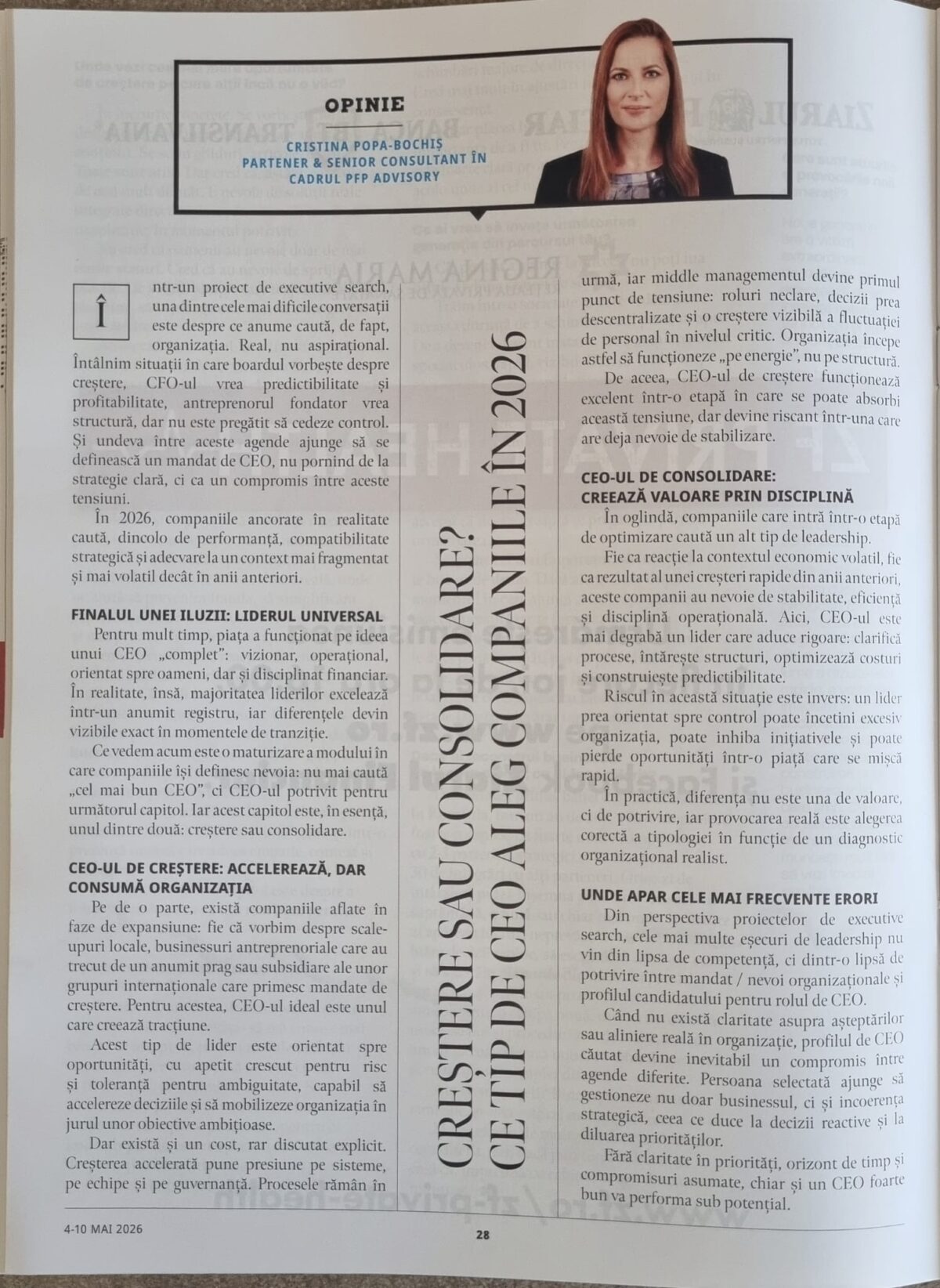
NEWS: Cristina Popa-Bochiş articol pentru BUSINESS MAGAZIN

Creştere sau consolidare? Ce tip de CEO aleg companiile în 2026

Articol scris de Cristina Popa-Bochiş, Partner & Senior Consultant în cadrul PFP Advisory, pentru publicația Business Magazin.


În recrutarea unui CEO, provocarea reală nu este identificarea celui mai bun lider, ci a liderului potrivit pentru etapa în care se află organizația. În practică, multe mandate sunt construite ca un compromis între așteptări diferite ale acționarilor, boardului și managementului, ceea ce face dificilă definirea clară a profilului căutat.

Articolul explorează diferențele dintre CEO-ul orientat spre creștere și CEO-ul orientat spre consolidare, riscurile asociate fiecărei tipologii și motivele pentru care multe eșecuri de leadership nu sunt generate de lipsa de competență, ci de lipsa de potrivire între lider și contextul organizațional.

Într-un mediu economic tot mai volatil, companiile caută lideri cu un nivel ridicat de adaptabilitate (AQ – Adaptability Quotient), capabili să accelereze sau să încetinească organizația atunci când contextul o cere, fără a pierde direcția strategică.

Concluzia este una simplă: organizațiile care reușesc să își clarifice prioritățile, obiectivele și compromisurile înainte de a începe procesul de recrutare au șanse mult mai mari să identifice liderul potrivit și să construiască premisele unui nou capitol de succes.

Citește articolul complet aici – https://www.businessmagazin.ro/opinii/cristina-popa-bochis-partener-senior-consultant-in-cadrul-pfp-23142868

Categorii
Corporate

Alexandra Ene on Euronews regarding the EU Pay Transparency Directive

Euronews invited Alexandra Ene, Managing Partner PFP Advisory, to discuss with Sonia Teodoriu the implementation of the EU Pay Transparency Directive and its impact on organizations in Romania.

Many companies in Romania are currently insufficiently prepared for this new stage of transparency and compliance. However, it is important for both employers and employees to understand that, although reporting obligations will begin next year, the deadline for transposing the directive into national legislation is June 2026.

In practice, the directive will require organizations to:

  • Evaluate roles and implement clear and transparent compensation structures;
  • Ensure equal pay for women and men performing the same work or work of equal value;
  • Communicate to employees both their individual remuneration level and the average remuneration levels for employees performing the same work or work of equal value within the organization;
  • Inform candidates during recruitment processes about the salary range associated with the role;
  • Report gender pay gap data for companies with more than 100 employees.

Beyond compliance, the directive is likely to force many organizations to reassess how compensation decisions are made, documented, and communicated internally. In practice, this is not only an HR or legal exercise, but also a leadership and organizational maturity topic, especially for companies that grew rapidly or developed compensation structures organically over time.

For many organizations, the real challenge will not be reporting itself, but the inconsistencies that transparency may expose: differences generated over time by negotiation practices, legacy structures, unclear role evaluations, or uneven managerial decisions.

Companies that prepare will likely navigate the transition with significantly less internal friction.

See the video here – https://www.youtube.com/watch?v=tU-VE-3Hu18

Read the article here – https://www.euronews.ro/articole/transparenta-salariala-bate-la-usa-cat-de-pregatite-sunt-companiile-si-ce-presupune-proiectul-de-lege

Categorii
Corporate

Why confidentiality matters in Executive Search projects

When companies in Romania engage an Executive Search firm, the conversation usually starts in the same place: the profile, the timeline, the market, the budget, etc. What doesn’t always gets discussed, or at least not directly, is how much of the project’s success depends on confidentiality. Not as a procedural formality, but as an active discipline that shapes whether a senior leadership search succeeds or quietly unravels.

In our experience running Executive Search projects across Romania and the broader CEE regional market, confidentiality is one of the important variables that separates well-managed processes from ones that create organizational disruption before a hiring decision is even made.

Executive Search in Romania operates in a small market

Romania’s leadership market is more interconnected than it appears from the outside. At C-suite and senior management level, namely CFO, Country Manager, Commercial Director, Operations Director, Plant Manager, etc., the relevant candidate pool is limited. People know each other, news travels, and in sectors like FMCG, financial services, manufacturing, real estate, or professional services, leadership communities are tight enough that a poorly contained search becomes visible within days.

This is the first thing companies often underestimate when starting an Executive Search process: in a market this size, information doesn’t need to be published publicly to circulate. It just needs to leave the room once.

Why leadership hiring signals more than companies intend

Replacing a senior leader is never a purely operational decision, and the market rarely reads it that way. A CFO transition might imply something about changes in financial governance or ownership direction, a new Commercial Director a shift in growth strategy, or a CEO search either planned succession or something more urgent.

These signals reach competitors, clients, suppliers, and internal teams faster than most companies prepare for. And once speculation starts, once the question „what’s happening there?” begins circulating, the company loses control of its own narrative at precisely the moment when narrative control matters most.

This is why Executive Search, at senior level, is always partly reputation management. The process itself communicates something about the organization, whether the company intends it to or not.

Where confidentiality breaks down in practice

Most confidentiality failures in Executive Search don’t come from one dramatic mistake. They accumulate through small process failures: a board member who mentions the search informally, a stakeholder who approaches candidates through their own network, interview feedback that circulates too widely, inconsistent messaging between what HR communicates and what the founder actually wants.

Each of these, on its own, seems minor. Together they create a process that is technically confidential, but functionally transparent to anyone in the market paying attention.

The most common root cause is governance that wasn’t defined clearly at the start: who knows about this search, what can be shared externally, who is authorized to communicate with candidates, and at what stage. Without explicit answers, the process fills in the gaps – and rarely in the company’s favor.

Speed matters here too. A search that stretches for months multiplies exposure at every stage. More people become aware of it, candidates discuss it in their own networks, speculation builds. And the strongest candidates, usually already in demanding roles, and already selective about the processes they engage with, begin to disengage. In Executive Search, a slow process is not just operationally inefficient, but a confidentiality risk in its own right.

Senior candidates are evaluating the process too

The profiles genuinely worth pursuing in a senior leadership search are rarely looking for a new role. They are visible professionals running business units, managing regional operations, leading transformation programs. Exploring a new opportunity carries real professional risk for them and if it becomes known prematurely, the consequences can be significant.

When a company doesn’t manage that exposure carefully, it doesn’t just lose a candidate. It loses credibility with the entire category of candidates it most needs to attract: experienced, high-performing leaders who are selective about which processes they engage with and which organizations they’re willing to be associated with.

The quality of how an Executive Search is conducted becomes part of the employer proposition. Senior professionals notice whether stakeholders are aligned, whether information is handled with discipline, whether the process respects their position. These aren’t peripheral impressions, they are inputs into a decision that is, ultimately, about whether this organization is one they want to join.

Internal missalignment can become a confidentiality issue

Many Executive Search challenges that appear to be about candidates are actually about internal misalignment. When the board describes one type of leader, the founder wants something different, the operational team has a third set of expectations, and HR communicates a fourth version externally – the process becomes unstable from the inside.

That instability generates fragmented, contradictory communication. And fragmented communication makes confidentiality nearly impossible to maintain, because uncertainty itself generates conversation.

A clearly aligned mandate, one where key stakeholders have done the work of agreeing before candidate outreach begins, doesn’t just attract better candidates. It produces a more contained, more defensible, more professionally managed process. Clarity is protective.

What a confidential Executive Search process actually looks like

The most professionally managed leadership searches share a consistent set of characteristics. The stakeholder group is small and explicitly defined, external communication is centralized, the mandate is aligned before the first candidate conversation, the process moves with deliberate speed, no unnecessary pauses, no extended silences that invite speculation, candidates are engaged selectively.

And throughout, the organization behaves in a way that reflects what’s actually at stake – not just in finding the right person, but in how the search itself is perceived by the market, internally and externally.

This is how a senior leadership search demonstrates something important to the candidates being recruited: that this is an organization capable of handling sensitive decisions with maturity. The strongest candidates are evaluating the role, but also whether this is the kind of organization they want to be visible within.

Working with an Executive Search Firm in Romania

The value of partnering with an experienced Executive Search firm in Romania goes beyond access to candidates. It includes process architecture, stakeholder alignment, candidate confidentiality management, and the kind of market discipline that keeps a sensitive search contained throughout its duration.

At PFP Advisory, we run retained Executive Search and senior management recruitment projects with a structured approach built around these principles. If you are planning a leadership transition, whether confidential succession, a newly created role, or a strategic replacement, we can walk you through how a well-managed process works in practice.


Want to learn more about our Executive Search services? Clieck here: https://pfpadvisory.com/about/


Categorii
Corporate

Balancing experience and potential in management recruitment

Decoding Talent Acquisition: Balancing experience and potential when recruiting a manager is a nuanced process that depends on the specific needs and goals of your organization. Here’s a breakdown of both perspectives:

Experience:
  • Proven Track Record: Experienced managers have background in handling various challenges, making them equipped to manage different situations more effectively. Encountering and resolving various issues in past roles equips senior candidates with problem-solving skills that can be applied to new situations. This can save time and resources when dealing with complex issues.
  • Immediate Impact: They often require less training and can contribute to the organization’s goals more quickly due to their familiarity with similar roles. They can often hit the ground running, being a what we call a “plug & play” profile.
  • Risk Reduction: Their experience can mean high-quality work and more appropriate decisions, reducing the potential for costly mistakes and allowing them to provide guidance to their team based on past experiences.
  • Reduced Learning Curve: Learning curves are inherent to any new role. However, experienced candidates often have a shorter learning curve, allowing them to adapt to new processes and technologies more swiftly.
  • Mentorship Potential: Experienced employees can serve as mentors to less experienced team members. They can provide guidance, share insights, and contribute to the growth and development of the team, facilitating knowledge transfer within the organization. Furthermore, having experienced mentors can help retain top talent, as employees value opportunities for growth and learning. When new hires see that the organization invests in their development by providing access to experienced mentors, they’re more likely to feel engaged and motivated to contribute effectively.
  • Client and Stakeholder Relations: In roles that involve interacting with clients and stakeholders, experienced candidates are more likely to have established relationships and a better understanding of client needs.
  • Leadership and Decision-Making: In managerial roles, experience often leads to better decision-making and effective leadership. Experienced managers can draw on past experiences to guide their teams and drive results.
  • Crisis Management: When unexpected challenges arise, experienced professionals tend to remain calm and composed, drawing from their past experiences to manage crises effectively.
  • Industry Insights: Experienced candidates bring insights about industry trends, competition, and market dynamics that can be invaluable in shaping business strategies.
  • Confidence and Poise: Another advantage of recruiting a person with experience is the confidence and poise they bring to their role. Seniority often equips individuals with a sense of assurance in their abilities. Having faced and overcome various challenges in their career, experienced professionals tend to approach new tasks and responsibilities with a level of self-assuredness. This confidence can have a positive impact on their performance, decision-making, and interactions with colleagues, clients, and stakeholders.

However, past performance does no guarantee future performance, which is why high potential candidates should still be in the run.

Potential:
  • Fresh Perspectives: Individuals with less experience, unburdened by preconceived notions, often bring to the table creative thinking, original viewpoints and innovative ideas that can challenge the status quo. This encourages a culture of continuous improvement and fosters a mindset of innovation which can drive the organization to explore new opportunities.
  • Adaptability: Potential-driven managers tend to be more open to learning and adapting to changing contexts, which is essential in today’s rapidly evolving business landscape. Their proactive approach to evolving circumstances can lead to the organization remaining responsive and resilient.
  • Long-Term Investment: By identifying and nurturing high-potential individuals, organizations make a strategic investment in their future top leadership pipeline. These candidates possess qualities that can be developed over time, aligning with the organization’s growth trajectory and long-term vision.
  • Eagerness to Learn: High-potential candidates are typically eager to learn and take on new challenges. Their curiosity can lead to continuous improvement and a culture of ongoing development.
  • Energy and Enthusiasm: Their enthusiasm and passion can be contagious, boosting team morale and motivation, and fostering a positive work environment. Thus, they could have an impact on team spirit, elevating engagement levels, and cultivating an atmosphere where challenges are seen as exciting opportunities to excel.
  • Resilience: High-potential candidates often exhibit a high level of determination and resilience, enabling them to bounce back from setbacks and persevere in the face of challenges.
  • Diverse Skill Sets: These candidates may come from various backgrounds, bringing miscellaneous skill sets that can complement and enrich the existing team’s capabilities. Their distinctive capabilitities could bring fresh dimensions to problem-solving and decision-making, driving well-rounded outcomes.
  • Leadership Potential: Even if they’re not stepping into a top role immediately, high-potential candidates often display leadership qualities that can be nurtured and developed over time.
  • Cultural Fit: Being relatively new to the organization, these candidates are more likely to embrace and embody the company’s culture, making integration smoother.
  • Retention and Engagement: Organizations that invest in high-potential individuals demonstrate a commitment to employee growth and development, which can lead to increased job satisfaction, engagement, and retention.
Finding the Balance:
  • Context Matters: Consider the specific role, team, and company goals. For critical positions requiring immediate results, experience might be prioritized. For roles with room for growth and innovation, potential could be more valuable.
  • Hybrid Approach: Look for candidates who offer a blend of both. Someone with a strong foundation of experience combined with a demonstrated hunger to learn and grow can be a valuable asset.
  • Assessment Tools: Utilize assessment tools, psychometric tests, competency-based interviews, simulations, and scenario-based assessments to gauge a candidate’s ability to handle real-world situations, regardless of experience.
  • Investment in Development: If you lean towards potential, ensure you have a solid plan for mentoring, training, and guiding the manager to meet your organization’s expectations.


In essence, the best approach is to prioritize what aligns with your organization’s immediate and long-term needs. Remember that each recruitment scenario is unique. Therefore, carefully evaluating candidates based on your organization’s circumstances and culture will yield the best outcome.