Categorii
Corporate

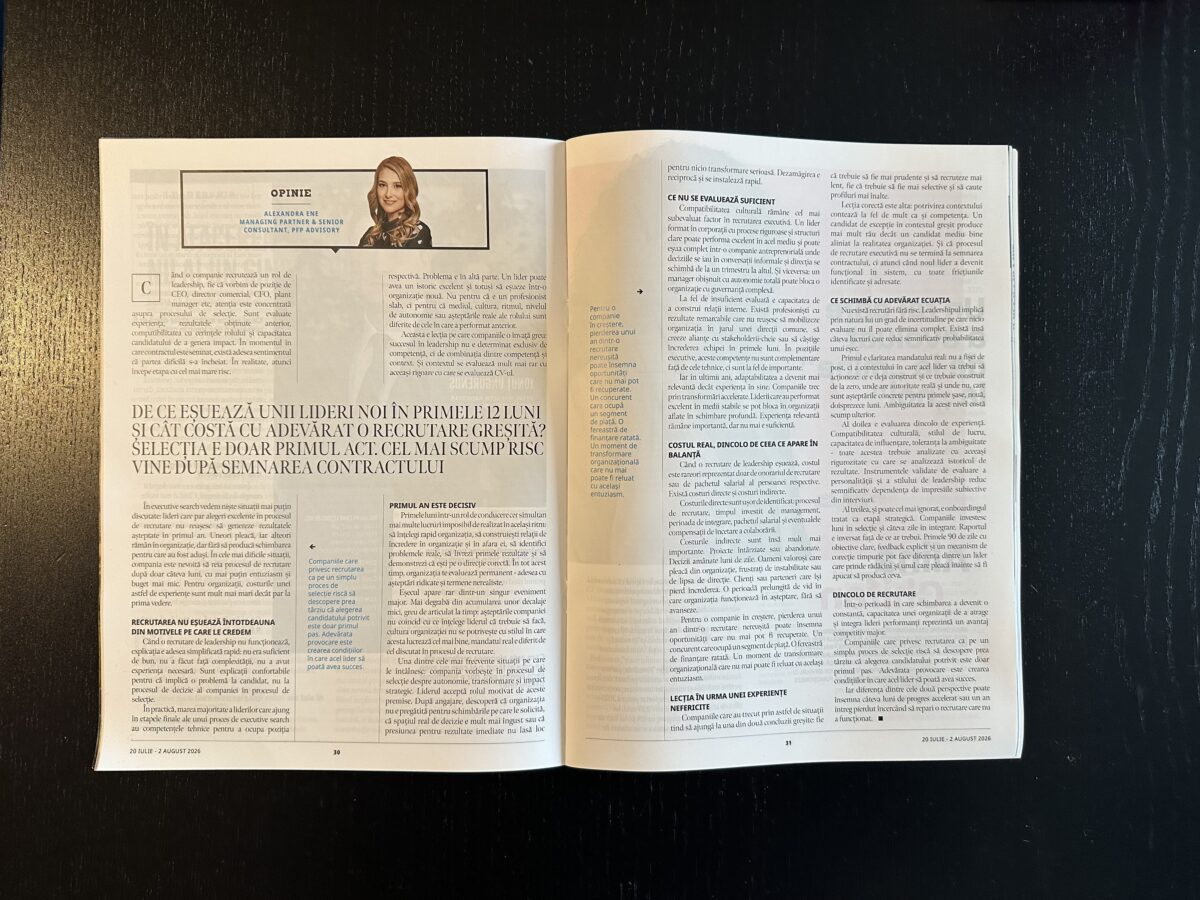
NEWS: Alexandra Ene articol pentru BUSINESS MAGAZIN

O recrutare pentru o poziție de leadership nu se încheie odată cu semnarea contractului. De multe ori, adevărata provocare începe abia atunci, când noul lider trebuie să se adapteze organizației, să construiască relații de încredere și să livreze rezultatele așteptate.

De ce unii lideri cu experiență solidă și rezultate profesionale remarcabile nu reușesc să performeze într-un context nou? Și cât costă, în realitate, o recrutare care nu funcționează?

Într-un articol publicat în Business Magazin, Alexandra Ene, Managing Partner PFP Advisory, analizează factorii care pot contribui la eșecul unei recrutări executive în primele 12 luni, de la diferențele dintre așteptările inițiale și mandatul real, până la compatibilitatea culturală, autonomia decizională și provocările integrării în organizație.

Articolul abordează și costurile mai puțin vizibile ale unei recrutări nereușite: proiecte întârziate, oportunități de business pierdute, instabilitate în echipă și decizii strategice amânate.

Ideea centrală: succesul unei recrutări executive nu depinde doar de alegerea unui candidat competent, ci și de înțelegerea contextului organizațional și de crearea condițiilor în care noul lider poate performa.Coa

Citiți articolul integral în Business Magazin: https://www.businessmagazin.ro/opinii/alexandra-ene-pfp-advisory-de-ce-esueaza-unii-lideri-noi-in-primele-12-luni-si-cat-costa-cu-adevarat-o-recrutare-gresita-selectia-e-doar-primul-act-cel-mai-scump-risc-vine-dupa-semnarea-contractului-23198795

Categorii
Jobs

Chief Financial Officer, Oradea

We are looking for an experienced Chief Financial Officer in Romania for our client, a prominent company in the services sector located in Oradea, Bihor county.


THE ROLE

The future Chief Financial Officer (CFO) should be a highly organized professional with deep financial and accounting expertise, specifically gained within service-oriented or manufacturing environments. You must bring strong technical knowledge to the table and fully grasp the operational workflows specific to service and production companies. The ideal candidate blends hands-on financial-accounting experience with proven team leadership skills and is genuinely excited to take on the challenge of a large-scale project.

Main Responsibilities:

  • Drives the setup of the financial-accounting department and oversees the rollout of the core accounting system;
  • Takes full ownership of the quality, accuracy, and compliance of all financial-accounting activities;
  • Collaborates with executive management to design and implement financial policies, processes, and corporate strategies;
  • Aligns departmental strategies to effectively reach overall business and financial goals;
  • Leads, manages, and supports all team members within the department;
  • Ensures accurate, real-time logging of all financial data within the system software, making sure that the transactions and economic activities are properly reflected in financial terms;
  • Coordinates and oversees corporate billing, collections, payments, and procurement processes;
  • Manages physical and digital inventory records
  • Handles downloading, processing, and validating inventory data within the corporate system;
  • Organizes and coordinates a comprehensive, general inventory audit at least once a year;
  • Partners with HR to recruit, select, hire, and train financial department staff;
  • Prepares periodic internal and external financial reports for stakeholders;
  • Establishes and organizes a reliable physical and digital archive for financial-accounting documents;
  • Coordinates and provides direct support during internal or external financial audits and controlling actions.


INTERNAL STRUCTURE

The future CFO will report to the General Manager, will manage the finance and accounting department and will closely collaborate with other stakeholders, as needed. The position is based in Oradea, Bihor.


THE CANDIDATE

Requirements:

  • Higher education degree in Economics;
  • Specialized coursework in Accounting;
  • Certified Public Accountant (CPA) / ACCA studies represents a strong plus;
  • A minimum of 10 years of experience in the economic / financial-accounting field and at least 2 years of experience in a managerial or leadership position;
  • Deep, practical knowledge of financial and management accounting;
  • Experienced in building, mentoring, and managing teams, as well as designing clear workflows and procedures;
  • Proven track record in setting up and structuring accounting systems;
  • Fully proficient in modern accounting software;
  • Fluent in English and Romanian, both spoken and written.


Professional profile:

  • A mature, high-integrity professional who values and respects organizational rules;
  • Constant attention to monitoring changes in the industry legislation;
  • Rigorous, well-organized, consistent, and exceptionally detail-oriented;
  • Strong analytical and synthesis skills, with a natural eye for spotting potential business risks;
  • Highly intelligent, proactive, and creative when developing risk-management strategies;
  • Very adaptable and quick to pick up new digital tools and systems.
Categorii
Corporate

POV: “Vrem pe cineva care să aducă schimbarea”

Una dintre cerințele frecvente în recrutările de management este: „Vrem pe cineva care să schimbe lucrurile.” Și, de fiecare dată, încerc să înțeleg ce înseamnă concret. Pentru că e ușor să spui că vrei un om care să vină cu o perspectivă nouă, să eficientizeze, să pună ordine, să ridice standardele, să schimbe mentalități etc. Mai greu este când omul respectiv chiar începe să facă asta.

Când un nou manager pune sub semnul întrebării procese vechi, cere date în loc de „așa știm noi că funcționează”, schimbă responsabilități, cere accountability sau spune că anumite lucruri trebuie făcute complet diferit, schimbarea începe să devină inconfortabilă. Și atunci se vede, de fapt, câtă schimbare poate tolera organizația.

Am văzut situații în care companiile căutau explicit oameni cu experiență de transformare și change management, dar, pe măsură ce intram mai mult în profunzimea rolului, devenea clar că spațiul real de schimbare era destul de limitat.

Și de aceea cred că merită făcut un exercițiu înainte să înceapă recrutarea:
– Ce vrem concret să schimbe acest om?
– Ce nu suntem pregătiți să schimbăm?
– Ce decizii va putea lua singur, fără să treacă prin cinci aprobări?
– Și cine îl va susține când schimbarea va deveni inconfortabilă?

Răspunsurile schimbă profilul candidatului pe care ar trebui să îl căutăm, pentru că nu orice companie are nevoie de un lider transformațional. Uneori are nevoie de cineva care să optimizeze ceea ce există, alteori, de cineva care să construiască, iar, în alte situații, chiar de cineva care să vină și să zdruncine puțin lucrurile.

Practic, înainte să definim profilul omului care trebuie să producă schimbarea, ar trebui să definim cât de pregătită este organizația să o primească. Altfel, riscăm să recrutăm exact omul pe care l-am căutat și să descoperim, câteva luni mai târziu, că nu este cel pe care organizația îl poate susține.


Postare scrisă de Alexandra Ene, Managing Partner PFP Advisory, pentru LinkedIn 

Categorii
Corporate

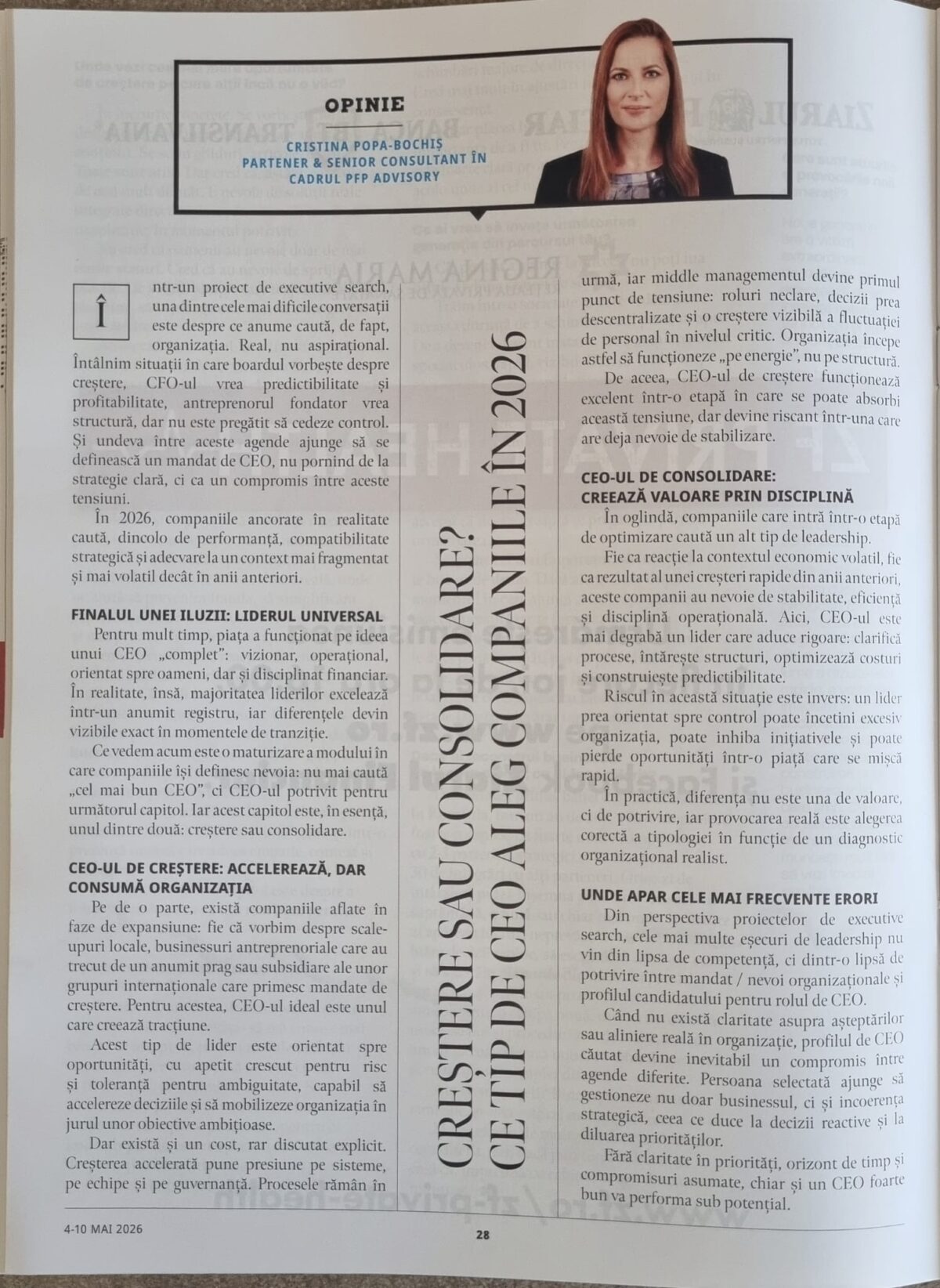
NEWS: Cristina Popa-Bochiş articol pentru BUSINESS MAGAZIN

Creştere sau consolidare? Ce tip de CEO aleg companiile în 2026

Articol scris de Cristina Popa-Bochiş, Partner & Senior Consultant în cadrul PFP Advisory, pentru publicația Business Magazin.


În recrutarea unui CEO, provocarea reală nu este identificarea celui mai bun lider, ci a liderului potrivit pentru etapa în care se află organizația. În practică, multe mandate sunt construite ca un compromis între așteptări diferite ale acționarilor, boardului și managementului, ceea ce face dificilă definirea clară a profilului căutat.

Articolul explorează diferențele dintre CEO-ul orientat spre creștere și CEO-ul orientat spre consolidare, riscurile asociate fiecărei tipologii și motivele pentru care multe eșecuri de leadership nu sunt generate de lipsa de competență, ci de lipsa de potrivire între lider și contextul organizațional.

Într-un mediu economic tot mai volatil, companiile caută lideri cu un nivel ridicat de adaptabilitate (AQ – Adaptability Quotient), capabili să accelereze sau să încetinească organizația atunci când contextul o cere, fără a pierde direcția strategică.

Concluzia este una simplă: organizațiile care reușesc să își clarifice prioritățile, obiectivele și compromisurile înainte de a începe procesul de recrutare au șanse mult mai mari să identifice liderul potrivit și să construiască premisele unui nou capitol de succes.

Citește articolul complet aici – https://www.businessmagazin.ro/opinii/cristina-popa-bochis-partener-senior-consultant-in-cadrul-pfp-23142868

Categorii
Corporate

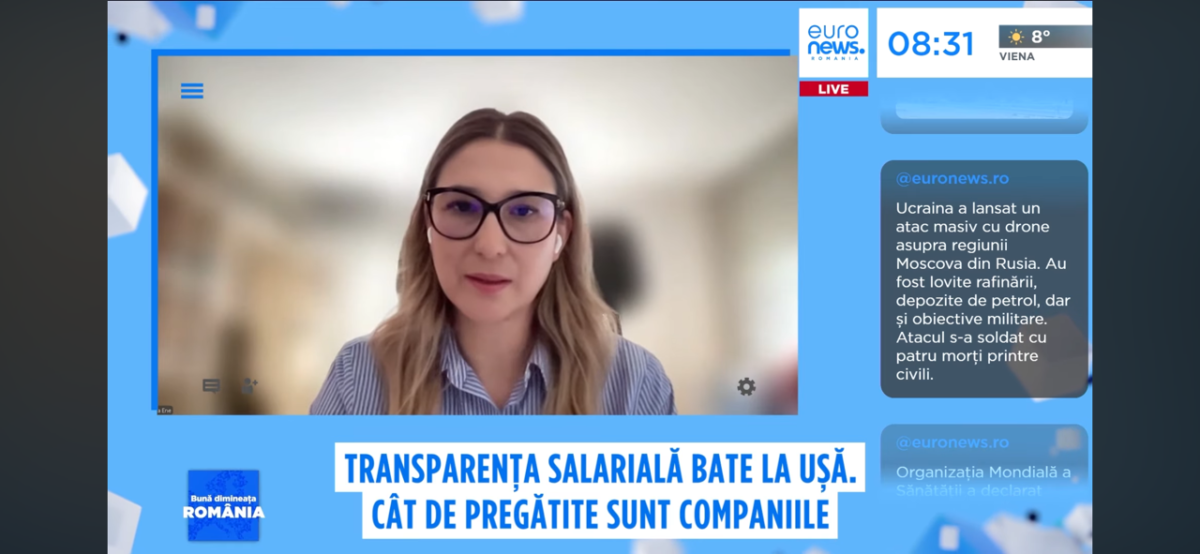
Alexandra Ene on Euronews regarding the EU Pay Transparency Directive

Euronews invited Alexandra Ene, Managing Partner PFP Advisory, to discuss with Sonia Teodoriu the implementation of the EU Pay Transparency Directive and its impact on organizations in Romania.

Many companies in Romania are currently insufficiently prepared for this new stage of transparency and compliance. However, it is important for both employers and employees to understand that, although reporting obligations will begin next year, the deadline for transposing the directive into national legislation is June 2026.

In practice, the directive will require organizations to:

  • Evaluate roles and implement clear and transparent compensation structures;
  • Ensure equal pay for women and men performing the same work or work of equal value;
  • Communicate to employees both their individual remuneration level and the average remuneration levels for employees performing the same work or work of equal value within the organization;
  • Inform candidates during recruitment processes about the salary range associated with the role;
  • Report gender pay gap data for companies with more than 100 employees.

Beyond compliance, the directive is likely to force many organizations to reassess how compensation decisions are made, documented, and communicated internally. In practice, this is not only an HR or legal exercise, but also a leadership and organizational maturity topic, especially for companies that grew rapidly or developed compensation structures organically over time.

For many organizations, the real challenge will not be reporting itself, but the inconsistencies that transparency may expose: differences generated over time by negotiation practices, legacy structures, unclear role evaluations, or uneven managerial decisions.

Companies that prepare will likely navigate the transition with significantly less internal friction.

See the video here – https://www.youtube.com/watch?v=tU-VE-3Hu18

Read the article here – https://www.euronews.ro/articole/transparenta-salariala-bate-la-usa-cat-de-pregatite-sunt-companiile-si-ce-presupune-proiectul-de-lege

Categorii
Corporate

Why confidentiality matters in Executive Search projects

When companies in Romania engage an Executive Search firm, the conversation usually starts in the same place: the profile, the timeline, the market, the budget, etc. What doesn’t always gets discussed, or at least not directly, is how much of the project’s success depends on confidentiality. Not as a procedural formality, but as an active discipline that shapes whether a senior leadership search succeeds or quietly unravels.

In our experience running Executive Search projects across Romania and the broader CEE regional market, confidentiality is one of the important variables that separates well-managed processes from ones that create organizational disruption before a hiring decision is even made.

Executive Search in Romania operates in a small market

Romania’s leadership market is more interconnected than it appears from the outside. At C-suite and senior management level, namely CFO, Country Manager, Commercial Director, Operations Director, Plant Manager, etc., the relevant candidate pool is limited. People know each other, news travels, and in sectors like FMCG, financial services, manufacturing, real estate, or professional services, leadership communities are tight enough that a poorly contained search becomes visible within days.

This is the first thing companies often underestimate when starting an Executive Search process: in a market this size, information doesn’t need to be published publicly to circulate. It just needs to leave the room once.

Why leadership hiring signals more than companies intend

Replacing a senior leader is never a purely operational decision, and the market rarely reads it that way. A CFO transition might imply something about changes in financial governance or ownership direction, a new Commercial Director a shift in growth strategy, or a CEO search either planned succession or something more urgent.

These signals reach competitors, clients, suppliers, and internal teams faster than most companies prepare for. And once speculation starts, once the question „what’s happening there?” begins circulating, the company loses control of its own narrative at precisely the moment when narrative control matters most.

This is why Executive Search, at senior level, is always partly reputation management. The process itself communicates something about the organization, whether the company intends it to or not.

Where confidentiality breaks down in practice

Most confidentiality failures in Executive Search don’t come from one dramatic mistake. They accumulate through small process failures: a board member who mentions the search informally, a stakeholder who approaches candidates through their own network, interview feedback that circulates too widely, inconsistent messaging between what HR communicates and what the founder actually wants.

Each of these, on its own, seems minor. Together they create a process that is technically confidential, but functionally transparent to anyone in the market paying attention.

The most common root cause is governance that wasn’t defined clearly at the start: who knows about this search, what can be shared externally, who is authorized to communicate with candidates, and at what stage. Without explicit answers, the process fills in the gaps – and rarely in the company’s favor.

Speed matters here too. A search that stretches for months multiplies exposure at every stage. More people become aware of it, candidates discuss it in their own networks, speculation builds. And the strongest candidates, usually already in demanding roles, and already selective about the processes they engage with, begin to disengage. In Executive Search, a slow process is not just operationally inefficient, but a confidentiality risk in its own right.

Senior candidates are evaluating the process too

The profiles genuinely worth pursuing in a senior leadership search are rarely looking for a new role. They are visible professionals running business units, managing regional operations, leading transformation programs. Exploring a new opportunity carries real professional risk for them and if it becomes known prematurely, the consequences can be significant.

When a company doesn’t manage that exposure carefully, it doesn’t just lose a candidate. It loses credibility with the entire category of candidates it most needs to attract: experienced, high-performing leaders who are selective about which processes they engage with and which organizations they’re willing to be associated with.

The quality of how an Executive Search is conducted becomes part of the employer proposition. Senior professionals notice whether stakeholders are aligned, whether information is handled with discipline, whether the process respects their position. These aren’t peripheral impressions, they are inputs into a decision that is, ultimately, about whether this organization is one they want to join.

Internal missalignment can become a confidentiality issue

Many Executive Search challenges that appear to be about candidates are actually about internal misalignment. When the board describes one type of leader, the founder wants something different, the operational team has a third set of expectations, and HR communicates a fourth version externally – the process becomes unstable from the inside.

That instability generates fragmented, contradictory communication. And fragmented communication makes confidentiality nearly impossible to maintain, because uncertainty itself generates conversation.

A clearly aligned mandate, one where key stakeholders have done the work of agreeing before candidate outreach begins, doesn’t just attract better candidates. It produces a more contained, more defensible, more professionally managed process. Clarity is protective.

What a confidential Executive Search process actually looks like

The most professionally managed leadership searches share a consistent set of characteristics. The stakeholder group is small and explicitly defined, external communication is centralized, the mandate is aligned before the first candidate conversation, the process moves with deliberate speed, no unnecessary pauses, no extended silences that invite speculation, candidates are engaged selectively.

And throughout, the organization behaves in a way that reflects what’s actually at stake – not just in finding the right person, but in how the search itself is perceived by the market, internally and externally.

This is how a senior leadership search demonstrates something important to the candidates being recruited: that this is an organization capable of handling sensitive decisions with maturity. The strongest candidates are evaluating the role, but also whether this is the kind of organization they want to be visible within.

Working with an Executive Search Firm in Romania

The value of partnering with an experienced Executive Search firm in Romania goes beyond access to candidates. It includes process architecture, stakeholder alignment, candidate confidentiality management, and the kind of market discipline that keeps a sensitive search contained throughout its duration.

At PFP Advisory, we run retained Executive Search and senior management recruitment projects with a structured approach built around these principles. If you are planning a leadership transition, whether confidential succession, a newly created role, or a strategic replacement, we can walk you through how a well-managed process works in practice.


Want to learn more about our Executive Search services? Clieck here: https://pfpadvisory.com/about/

Categorii
Corporate

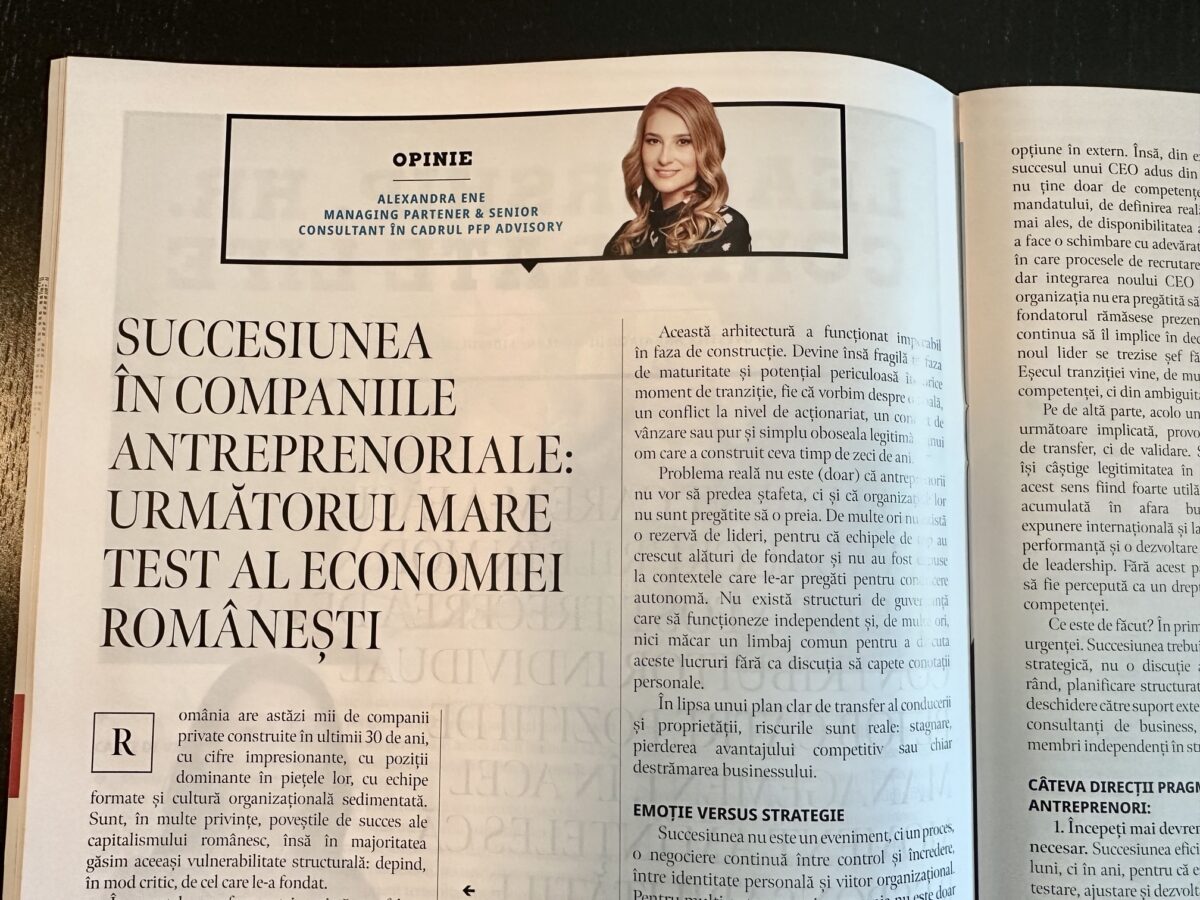
NEWS: Alexandra Ene articol pentru BUSINESS MAGAZIN

Succesiunea în companiile antreprenoriale – următorul mare test al economiei româneşti

Articol scris de Alexandra Ene, Managing Partner & Senior Consultant în cadrul PFP Advisory, pentru publicația Business Magazin.


Succesiunea în companiile antreprenoriale devine unul dintre cele mai importante teste pentru economia românească în perioada următoare, pe fondul maturizării primei generații de antreprenori post-’90. Articolul subliniază că, dincolo de transferul formal de ownership sau management, succesiunea este în esență un proces complex de transformare strategică, care implică redefinirea rolurilor, a culturii organizaționale și a modului de luare a deciziilor.

În practică, una dintre principalele provocări este lipsa unei planificări reale: multe organizații evită conversațiile dificile legate de retragerea fondatorului, delegarea puterii sau pregătirea unei noi generații de leadership. În absența unui proces structurat, riscurile sunt semnificative: de la blocaje decizionale și pierderea direcției strategice până la erodarea valorii companiei.

Articolul evidențiază că succesul succesiunii nu ține doar de identificarea unui „înlocuitor”, ci de alinierea dintre viziunea viitorului lider, etapa de dezvoltare a companiei și disponibilitatea organizației de a accepta schimbarea. Fie că vorbim despre membri ai familiei, management intern sau lideri externi, criteriul critic devine compatibilitatea strategică, nu doar continuitatea.

Concluzia este clară: companiile care tratează succesiunea ca pe un proces de leadership și guvernanță, nu ca pe un eveniment punctual, au șanse reale să conserve valoarea construită și să o ducă mai departe într-un context economic tot mai volatil.

Citete articolul complet aici – https://www.businessmagazin.ro/opinii/alexandra-ene-pfp-advisory-succesiunea-in-companiile-antreprenoriale-23114476

Categorii
Corporate

NEWS: Alexandra Ene articol pentru Republica.ro

Ce fac diferit liderii care performează: 10 observații din Executive Search

Diferența dintre un lider care crește o organizație și unul care o ține pe loc nu stă în CV sau diplome, ci în comportamente recurente. După sute de interviuri și procese de executive search locale și internaționale, Alexandra Ene, Managing Partner PFP Advisory, a identificat cele 10 lucruri pe care liderii cu adevărat performanți le fac diferit.

1. Știu ce nu știu.

2. Iau decizii cu informații incomplete.

3. Angajează oameni care îi pot contrazice.

4. Separă urgentul de important.

5. Tratează plecările din echipă ca pe informație, nu ca pe eșec.

6. Nu confundă loialitatea cu performanța.

7. Își protejează energia pentru deciziile care contează.

8. Au trecut printr-un eșec major și l-au procesat.

9. Nu recrutează când le e foame.

10. Știu să citească o încăpere.

Aceste comportamente nu se predau în niciun MBA. Se formează prin experiență, decizii asumate și eșecuri procesate onest. Liderii care le au sunt puțini și exact de aceea fac diferența.


Citește articol complet pe website-ul Republica.ro: https://republica.ro/am-intervievat-sute-de-lideri-ce-fac-diferit-cei-care-performeaza

Categorii
Corporate

NEWS: PFP Advisory featured in Revista CARIERE

We are pleased to share that Revista CARIERE recently featured the announcement of Cristina Popa-Bochiș joining PFP Advisory as Partner.

While this step was officially announced at the beggining of 2026, the partnership already reflects in the way we approach executive search and leadership advisory mandates – with deeper industry insight and an even more strategic lens on leadership impact.

Cristina brings extensive executive search experience and a nuanced understanding of organizational dynamics, strengthening our capability to support boards, entrepreneurs, and senior executives in critical leadership decisions.

We thank Revista CARIERE for covering this important milestone.

You can read the full article here: https://www.revistacariere.ro/leadership/on-the-move/piata-de-executive-search-cristina-popa-bochis-devine-partener-in-cadrul-pfp-advisory