Categorii
Corporate

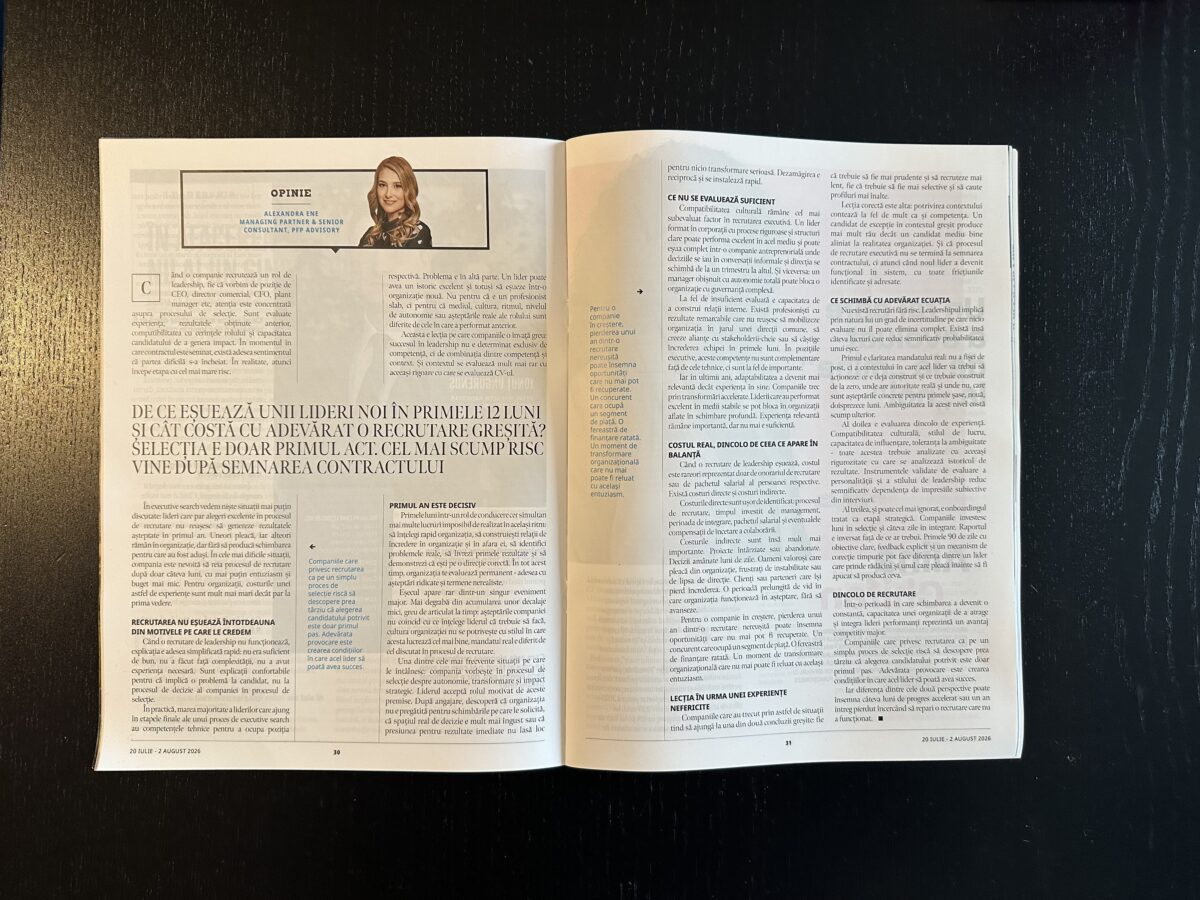
NEWS: Alexandra Ene articol pentru BUSINESS MAGAZIN

O recrutare pentru o poziție de leadership nu se încheie odată cu semnarea contractului. De multe ori, adevărata provocare începe abia atunci, când noul lider trebuie să se adapteze organizației, să construiască relații de încredere și să livreze rezultatele așteptate.

De ce unii lideri cu experiență solidă și rezultate profesionale remarcabile nu reușesc să performeze într-un context nou? Și cât costă, în realitate, o recrutare care nu funcționează?

Într-un articol publicat în Business Magazin, Alexandra Ene, Managing Partner PFP Advisory, analizează factorii care pot contribui la eșecul unei recrutări executive în primele 12 luni, de la diferențele dintre așteptările inițiale și mandatul real, până la compatibilitatea culturală, autonomia decizională și provocările integrării în organizație.

Articolul abordează și costurile mai puțin vizibile ale unei recrutări nereușite: proiecte întârziate, oportunități de business pierdute, instabilitate în echipă și decizii strategice amânate.

Ideea centrală: succesul unei recrutări executive nu depinde doar de alegerea unui candidat competent, ci și de înțelegerea contextului organizațional și de crearea condițiilor în care noul lider poate performa.Coa

Citiți articolul integral în Business Magazin: https://www.businessmagazin.ro/opinii/alexandra-ene-pfp-advisory-de-ce-esueaza-unii-lideri-noi-in-primele-12-luni-si-cat-costa-cu-adevarat-o-recrutare-gresita-selectia-e-doar-primul-act-cel-mai-scump-risc-vine-dupa-semnarea-contractului-23198795

Categorii
Jobs

Senior Presales Consultant, Bucharest

We are looking for a Senior Presales Consultant in Bucharest for our client, a leading IT system integrator in Romania.


THE ROLE

The Retail Presales Consultant serves as the bridge between the retailer’s operational needs and the solution that the organization can deliver. He/She translates in-store requirements—such as checkout waiting times, losses, stock accuracy, cash handling, and rollouts across hundreds of locations—into functional architectures, technical proposals, and business cases. Additionally, the Presales Consultant coordinates in-store demonstrations and pilots, ensuring that everything discussed with the Sales and Business Development teams during the commercial phase can be successfully delivered by the product and delivery teams.

His/Her core responsibility is centered on ensuring the technical-functional quality of the proposed solution, the accuracy of estimated costs, and the feasibility of commitments made to the client.

Main responsibilities

  1. Solutioning and business analysis
  • Conducts client discovery sessions and documents complex workflows;
  • Defines the technical solution (software/hardware/services) and functional architecture, potentially replicable for large (multi-location) projects;
  • Builds solid business cases (ROI, TCO, inventory optimization, and cash handling).
  1. Commercial support, demos, and PoC
  • Provides technical support to sales teams throughout the entire commercial cycle through technical validation, presentations, workshops, demos, and Proof of Concept (PoC);
  • Defines with the main stakeholders the success criteria, deliverables, and scenarios for PoC.
  1. Bidding, RFP, and tenders
  • Prepares the drafting of technical proposals, specifications, and profitability estimations;
  • Coordinates responses for complex public (SEAP/SICAP) and private tenders, ensuring compliance.
  1. Interface with Product Management and Delivery
  • Aligns major client requirements with the product roadmap and technical feasibility;
  • Ensures a strategic handover to Project Management and Delivery teams at the kickoff of projects.
  1. Partnerships and portfolio development
  • Manages the technical and strategic relationship with manufacturers and suppliers of hardware and software solutions;
  • Develops new solutions and services to expand the organization’s commercial portfolio.
  1. Internal enablement and materials
  • Defines the client approach strategy and conducts internal demo/training sessions;
  • Collaborates with Marketing to establish key messaging and competitive differentiators for the solutions.


INTERNAL STRUCTURE

The future Presales Consultant will be part of the Commercial team, reporting directly to the Presales & Product Management Manager. The role will work closely with key internal teams, including Sales, Product Management, Delivery, Project Management, QA, Marketing, and Service.


THE CANDIDATE

Experience

  • Completed higher education – technical or economic profile, or equivalent through relevant experience;
  • Minimum 5 years of experience with retail solutions, acquired within an IT solutions integrator (presales, solution consulting, business analysis, product management, or IT solutions implementation) or within a retail organization (with exposure to complex IT solutions – IT, operations, stores, logistics);
  • Ability to understand an organization’s business processes and translate them into functional requirements;
  • Demonstrable experience in drafting structured documentation: analyses, specifications, tender books (RFP/RFIs), and technical proposals;
  • English language – advanced level, both written and conversational (technical documentation and interaction with international suppliers); another foreign language is a plus;
  • Strong presentation and interpersonal skills, including in front of a mixed audience (both business and IT);
  • Availability to travel approximately 20% of the time to client locations, stores and warehouses across Romania and the Republic of Moldova; Category B driving license required.

Mindset

  • Can-do attitude and self-learner;
  • Ability to bring structure and compile information in complex business cases;
  • Strong execution and follow-through;
  • Ability to develop and empower people. 

You are someone who:

  • Is ambitious, digital and tech savvy;
  • Communicates transparently and works well across functions, clients and partners;
  • Is curious about new technologies and product lines in the field;
  • Provides solutions in a structured way.


Why This Role:

  • High-visibility role – direct contribution to what is included or excluded from the retail portfolio and the company roadmap;
  • Clear ownership of a vertical: complete management of retail solutions, both owned and from international partners;
  • Hybrid work schedule, with flexibility based on client agendas;
  • Dedicated budget for training and certifications on solutions and technologies within the portfolio, as well as participation in industry events;
  • Salary package aligned with experience, plus standard Company benefits (medical insurance, meal vouchers, etc.);
  • An established Presales & Product Management team with clear governance processes—ensuring transparency on who decides what and based on which criteria.
Categorii
Candidates

POV: Recomandări pentru candidați

Sunt activă în recrutarea de poziții de top și middle management de aproape 10 ani și văd anumite greșeli care se repetă. Câteva recomandări pentru candidați, din situații pe care le întâlnesc destul de des:

– Salvați și trimiteți CV-ul cu numele vostru, nu „CV final”, „CV nou” sau „CV 2026”. Preferabil în .pdf, dar fără parolă sau blocat, ca să poată fi deschis și copiat ușor.
– Adresa de email de pe care trimiteți să fie profesională (fără pisicutza@ sau contul vecinului) și setați numele de afișare astfel încât să conțină numele vostru. Dacă v-ați schimbat numele după căsătorie, verificați dacă adresa mai poate fi asociată cu voi.
– Datele de contact să fie actualizate și ușor de găsit.
– Titlurile rolurilor să fie clare, nu doar denumiri interne din companie. Un mare plus când adăugați și industria în care activează companiile, nu avem cum să cunoaștem toți angajatorii din piață.
– Scrieți emailurile simplu și natural, în limba în care ați purta și o conversație cu persoana respectivă. Limba engleză este într-adevăr mai folosită în JD-uri și CV-uri, dar un mesaj sau email de la un român către un român nu are de ce să fie în altă limbă.
– Pe cât posibil, recomand să nu trimiteți texte generate integral de AI. Se recunosc și au început să sune toate la fel. Folosiți-l ca ajutor, dacă e cazul, dar lăsați mesajul să fie al vostru.
– LinkedIn-ul să fie actualizat și în linie cu CV-ul. Atenție ca perioadele de angajare să fie corecte și consecvente între platforme, neconcordanțele ridică semne de întrebare.
– Aplicați la roluri care au o legătură rezonabilă cu experiența voastră. Nu trebuie să bifați 100% din cerințe, dar când vedeți subliniat că o anumită experiență / competență este esențială pentru rol, țineți cont de acest lucru.
– Citiți descrierea rolului (și a companiei angajatoare, dacă o cunoașteți) înainte de interviu.
– Dacă ați confirmat un interviu și nu mai puteți ajunge, anunțați.
– Nu trimiteți același mesaj generic către 20 de recrutori, mai ales dacă suntem toți în TO sau CC 🫠.


Acest text a fost postat pe profilul de LinkedIn al Alexandrei Ene, Managing Partner PFP Advisory.

Categorii
Jobs

Operations Director, food production, Bucharest

We are looking for an Operations Director for one of our clients, an international company operating in the food production industry. The position is based in Bucharest.

THE ROLE

The Operations Director is responsible for the overall management and performance of the manufacturing operations, covering Production, Technical (Maintenance), and Supply Chain functions.

A key mandate of the role is to drive the further development and modernization of operations, improving efficiency and cost performance through process optimization, automation, Continuous Improvement, and stronger performance management. The Operations Director will play an important role in strengthening operational processes and KPIs and building a more structured, data-driven approach to plant management.

As a member of the local management team, the Operations Director contributes to the company’s strategic objectives and works closely with both local and Group functions.

Main responsibilities

  • Leading plant operations across Production, Technical/Maintenance and Supply Chain;
  • Improving operational efficiency, productivity and cost performance;
  • Overseeing production planning and execution and ensuring effective use of resources;
  • Coordinating Supply Chain activities, including planning, logistics and procurement;
  • Managing the operations budget and monitoring key operational and financial KPIs;
  • Driving Continuous Improvement and Lean initiatives across operations;
  • Identifying and implementing opportunities for process optimization, automation and operational modernization;
  • Overseeing operational investment and improvement projects;
  • Ensuring compliance with relevant quality, food safety and environmental standards;
  • Leading and developing the operational management team and strengthening accountability and performance;
  • Collaborating closely with local management and relevant Group functions.

 THE CANDIDATE

Requirements

  • Minimum 10 years of relevant professional experience in manufacturing operations, including experience in a similar leadership position within FMCG food;
  • Background in managing production operations and multidisciplinary operational teams;
  • Solid Supply Chain management experience, ideally with direct exposure to procurement and sourcing;
  • Proven track record of successfully implementing production optimization, automation, and efficiency improvement projects;
  • Strong knowledge and practical experience of Lean Manufacturing and Continuous Improvement methodologies;
  • Knowledge of relevant quality, environmental and food safety management systems;
  • Strong leadership skills, with the ability to develop teams and drive accountability;
  • Strategic and results-oriented mindset, combined with a structured and disciplined approach to execution;
  • Strong analytical, problem-solving and organizational skills;
  • University degree;
  • Fluency in English and Romanian.


Why This Role:

  • Broad operational leadership role with responsibility across key plant functions;
  • Opportunity to lead the transformation and modernization of operations, including process improvement, automation and Continuous Improvement;
  • Direct impact on operational performance, cost efficiency and the future development of the manufacturing organization.
Categorii
Jobs

Commercial Director, FMCG food, Bucharest

We are looking for a Commercial Director for one of our clients, an international company operating in the FMCG sector. The position is based in Bucharest.


THE ROLE

The Commercial Director will take responsibility for the local commercial agenda, covering sales, marketing, key account development, and commercial performance.

Operating within a lean local structure, the role combines  strategic responsibility with a high degree of hands-on involvement. It is therefore particularly suited to a commercially mature leader who is comfortable moving between strategy, key customer discussions, team coordination and direct execution.

This is a build-and-develop mandate, focused on driving profitable growth, strengthening key customer relationships and further developing the commercial function to support the Company’s growth objectives.

Main responsibilities

  • Defining and executing the commercial strategy in alignment with local and Group objectives;
  • Driving profitable growth and identifying new business opportunities across customers, channels and categories;
  • Managing and further developing strategic customer relationships, including leading key commercial negotiations;
  • Defining pricing and promotional strategies, with a strong focus on margins, profitability and sales mix;
  • Leading and coordinating the sales and marketing agenda;
  • Identifying market and category opportunities and supporting new product and business development initiatives;
  • Leading commercial planning, budgeting and forecasting and monitoring key commercial and financial performance indicators;
  • Monitoring market and competitive dynamics to support commercial decision-making;
  • Strengthening commercial processes, performance discipline and accountability;
  • Leading and aligning the commercial team towards the Company’s objectives.


THE CANDIDATE

Professional Profile

  • An FMCG professional, commercially driven and business-minded, with a strong focus on profitable growth;
  • Strategic and analytical, yet pragmatic and hands-on;
  • Entrepreneurial and opportunity-oriented;
  • A strong negotiator and relationship builder, comfortable engaging senior stakeholders;
  • Structured and performance-oriented, with the ability to bring discipline and accountability;
  • A credible and mature leader, able to manage team dynamics effectively;
  • Autonomous and comfortable operating within an international environment.

Requirements

  • Minimum 10 years of relevant FMCG commercial experience, primarily within Sales;
  • Background in the food sector;
  • Strong knowledge of the Romanian Modern Trade market and experience working with international key accounts;
  • Experience with HoReCa customers would be an advantage;
  • Proven experience in complex commercial negotiations;
  • Strong understanding of pricing, margins, profitability and P&L principles;
  • Experience with commercial planning, budgeting and forecasting;
  • Experience coordinating teams and operating across both strategic and operational levels;
  • Exposure to Trade Marketing and/or Marketing;
  • Fluent English and Romanian.
Categorii
Corporate

POV: “Vrem pe cineva care să aducă schimbarea”

Una dintre cerințele frecvente în recrutările de management este: „Vrem pe cineva care să schimbe lucrurile.” Și, de fiecare dată, încerc să înțeleg ce înseamnă concret. Pentru că e ușor să spui că vrei un om care să vină cu o perspectivă nouă, să eficientizeze, să pună ordine, să ridice standardele, să schimbe mentalități etc. Mai greu este când omul respectiv chiar începe să facă asta.

Când un nou manager pune sub semnul întrebării procese vechi, cere date în loc de „așa știm noi că funcționează”, schimbă responsabilități, cere accountability sau spune că anumite lucruri trebuie făcute complet diferit, schimbarea începe să devină inconfortabilă. Și atunci se vede, de fapt, câtă schimbare poate tolera organizația.

Am văzut situații în care companiile căutau explicit oameni cu experiență de transformare și change management, dar, pe măsură ce intram mai mult în profunzimea rolului, devenea clar că spațiul real de schimbare era destul de limitat.

Și de aceea cred că merită făcut un exercițiu înainte să înceapă recrutarea:
– Ce vrem concret să schimbe acest om?
– Ce nu suntem pregătiți să schimbăm?
– Ce decizii va putea lua singur, fără să treacă prin cinci aprobări?
– Și cine îl va susține când schimbarea va deveni inconfortabilă?

Răspunsurile schimbă profilul candidatului pe care ar trebui să îl căutăm, pentru că nu orice companie are nevoie de un lider transformațional. Uneori are nevoie de cineva care să optimizeze ceea ce există, alteori, de cineva care să construiască, iar, în alte situații, chiar de cineva care să vină și să zdruncine puțin lucrurile.

Practic, înainte să definim profilul omului care trebuie să producă schimbarea, ar trebui să definim cât de pregătită este organizația să o primească. Altfel, riscăm să recrutăm exact omul pe care l-am căutat și să descoperim, câteva luni mai târziu, că nu este cel pe care organizația îl poate susține.


Postare scrisă de Alexandra Ene, Managing Partner PFP Advisory, pentru LinkedIn 

Categorii
Corporate

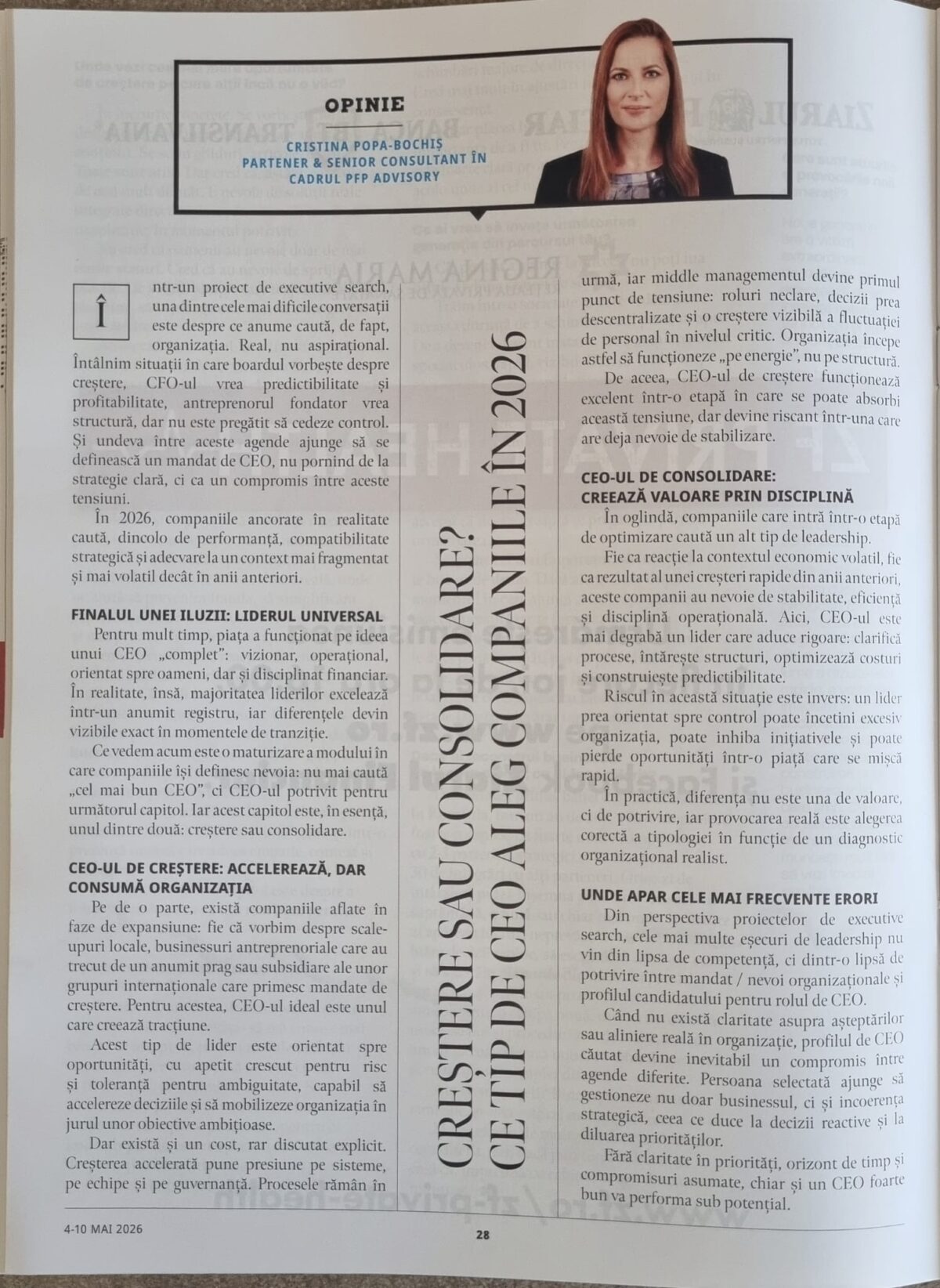
NEWS: Cristina Popa-Bochiş articol pentru BUSINESS MAGAZIN

Creştere sau consolidare? Ce tip de CEO aleg companiile în 2026

Articol scris de Cristina Popa-Bochiş, Partner & Senior Consultant în cadrul PFP Advisory, pentru publicația Business Magazin.


În recrutarea unui CEO, provocarea reală nu este identificarea celui mai bun lider, ci a liderului potrivit pentru etapa în care se află organizația. În practică, multe mandate sunt construite ca un compromis între așteptări diferite ale acționarilor, boardului și managementului, ceea ce face dificilă definirea clară a profilului căutat.

Articolul explorează diferențele dintre CEO-ul orientat spre creștere și CEO-ul orientat spre consolidare, riscurile asociate fiecărei tipologii și motivele pentru care multe eșecuri de leadership nu sunt generate de lipsa de competență, ci de lipsa de potrivire între lider și contextul organizațional.

Într-un mediu economic tot mai volatil, companiile caută lideri cu un nivel ridicat de adaptabilitate (AQ – Adaptability Quotient), capabili să accelereze sau să încetinească organizația atunci când contextul o cere, fără a pierde direcția strategică.

Concluzia este una simplă: organizațiile care reușesc să își clarifice prioritățile, obiectivele și compromisurile înainte de a începe procesul de recrutare au șanse mult mai mari să identifice liderul potrivit și să construiască premisele unui nou capitol de succes.

Citește articolul complet aici – https://www.businessmagazin.ro/opinii/cristina-popa-bochis-partener-senior-consultant-in-cadrul-pfp-23142868

Categorii
Candidates Corporate

POV: Observații despre leadership din executive search

În ultimii ani, unul dintre lucrurile pe care le observ tot mai des la liderii foarte buni este că au devenit mult mai puțin preocupați să pară că au toate răspunsurile. Pun întrebări mai bune, cer feedback real, își schimbă opinia când apar informații noi, recunosc mai ușor când ceva nu funcționează, vorbesc onest (și) despre greșelile pe care le-au făcut.

Și, poate cel mai important, nu mai construiesc organizații dependente de ei.

Liderii care performează bine în perioade complicate nu sunt cei care conduc prin presiune, control sau urgență permanentă, ci cei care reușesc să păstreze claritate, prioritizare și un anumit echilibru în organizație chiar și în momente mai dificile.

În recrutare, diferența asta o vedem între cei care vor să pară că lucrurile nu le scapă niciodată de sub control și vor să conducă fiecare conversație, și cei vorbesc despre cum au construit echipe și structuri menite să funcționeze sănătos și fără prezența lor constantă.

Cred că leadershipul modern seamănă mai puțin cu imaginea clasică a „omului care știe și face tot” și mai mult cu capacitatea de a adapta, de a învăța, de a crește oameni și de a păstra organizația funcțională într-un context care se schimbă permanent.

Postare publicată de Alexandra Ene pe LinkedIn.

Categorii
Corporate

Why confidentiality matters in Executive Search projects

When companies in Romania engage an Executive Search firm, the conversation usually starts in the same place: the profile, the timeline, the market, the budget, etc. What doesn’t always gets discussed, or at least not directly, is how much of the project’s success depends on confidentiality. Not as a procedural formality, but as an active discipline that shapes whether a senior leadership search succeeds or quietly unravels.

In our experience running Executive Search projects across Romania and the broader CEE regional market, confidentiality is one of the important variables that separates well-managed processes from ones that create organizational disruption before a hiring decision is even made.

Executive Search in Romania operates in a small market

Romania’s leadership market is more interconnected than it appears from the outside. At C-suite and senior management level, namely CFO, Country Manager, Commercial Director, Operations Director, Plant Manager, etc., the relevant candidate pool is limited. People know each other, news travels, and in sectors like FMCG, financial services, manufacturing, real estate, or professional services, leadership communities are tight enough that a poorly contained search becomes visible within days.

This is the first thing companies often underestimate when starting an Executive Search process: in a market this size, information doesn’t need to be published publicly to circulate. It just needs to leave the room once.

Why leadership hiring signals more than companies intend

Replacing a senior leader is never a purely operational decision, and the market rarely reads it that way. A CFO transition might imply something about changes in financial governance or ownership direction, a new Commercial Director a shift in growth strategy, or a CEO search either planned succession or something more urgent.

These signals reach competitors, clients, suppliers, and internal teams faster than most companies prepare for. And once speculation starts, once the question „what’s happening there?” begins circulating, the company loses control of its own narrative at precisely the moment when narrative control matters most.

This is why Executive Search, at senior level, is always partly reputation management. The process itself communicates something about the organization, whether the company intends it to or not.

Where confidentiality breaks down in practice

Most confidentiality failures in Executive Search don’t come from one dramatic mistake. They accumulate through small process failures: a board member who mentions the search informally, a stakeholder who approaches candidates through their own network, interview feedback that circulates too widely, inconsistent messaging between what HR communicates and what the founder actually wants.

Each of these, on its own, seems minor. Together they create a process that is technically confidential, but functionally transparent to anyone in the market paying attention.

The most common root cause is governance that wasn’t defined clearly at the start: who knows about this search, what can be shared externally, who is authorized to communicate with candidates, and at what stage. Without explicit answers, the process fills in the gaps – and rarely in the company’s favor.

Speed matters here too. A search that stretches for months multiplies exposure at every stage. More people become aware of it, candidates discuss it in their own networks, speculation builds. And the strongest candidates, usually already in demanding roles, and already selective about the processes they engage with, begin to disengage. In Executive Search, a slow process is not just operationally inefficient, but a confidentiality risk in its own right.

Senior candidates are evaluating the process too

The profiles genuinely worth pursuing in a senior leadership search are rarely looking for a new role. They are visible professionals running business units, managing regional operations, leading transformation programs. Exploring a new opportunity carries real professional risk for them and if it becomes known prematurely, the consequences can be significant.

When a company doesn’t manage that exposure carefully, it doesn’t just lose a candidate. It loses credibility with the entire category of candidates it most needs to attract: experienced, high-performing leaders who are selective about which processes they engage with and which organizations they’re willing to be associated with.

The quality of how an Executive Search is conducted becomes part of the employer proposition. Senior professionals notice whether stakeholders are aligned, whether information is handled with discipline, whether the process respects their position. These aren’t peripheral impressions, they are inputs into a decision that is, ultimately, about whether this organization is one they want to join.

Internal missalignment can become a confidentiality issue

Many Executive Search challenges that appear to be about candidates are actually about internal misalignment. When the board describes one type of leader, the founder wants something different, the operational team has a third set of expectations, and HR communicates a fourth version externally – the process becomes unstable from the inside.

That instability generates fragmented, contradictory communication. And fragmented communication makes confidentiality nearly impossible to maintain, because uncertainty itself generates conversation.

A clearly aligned mandate, one where key stakeholders have done the work of agreeing before candidate outreach begins, doesn’t just attract better candidates. It produces a more contained, more defensible, more professionally managed process. Clarity is protective.

What a confidential Executive Search process actually looks like

The most professionally managed leadership searches share a consistent set of characteristics. The stakeholder group is small and explicitly defined, external communication is centralized, the mandate is aligned before the first candidate conversation, the process moves with deliberate speed, no unnecessary pauses, no extended silences that invite speculation, candidates are engaged selectively.

And throughout, the organization behaves in a way that reflects what’s actually at stake – not just in finding the right person, but in how the search itself is perceived by the market, internally and externally.

This is how a senior leadership search demonstrates something important to the candidates being recruited: that this is an organization capable of handling sensitive decisions with maturity. The strongest candidates are evaluating the role, but also whether this is the kind of organization they want to be visible within.

Working with an Executive Search Firm in Romania

The value of partnering with an experienced Executive Search firm in Romania goes beyond access to candidates. It includes process architecture, stakeholder alignment, candidate confidentiality management, and the kind of market discipline that keeps a sensitive search contained throughout its duration.

At PFP Advisory, we run retained Executive Search and senior management recruitment projects with a structured approach built around these principles. If you are planning a leadership transition, whether confidential succession, a newly created role, or a strategic replacement, we can walk you through how a well-managed process works in practice.


Want to learn more about our Executive Search services? Clieck here: https://pfpadvisory.com/about/

Categorii
Corporate

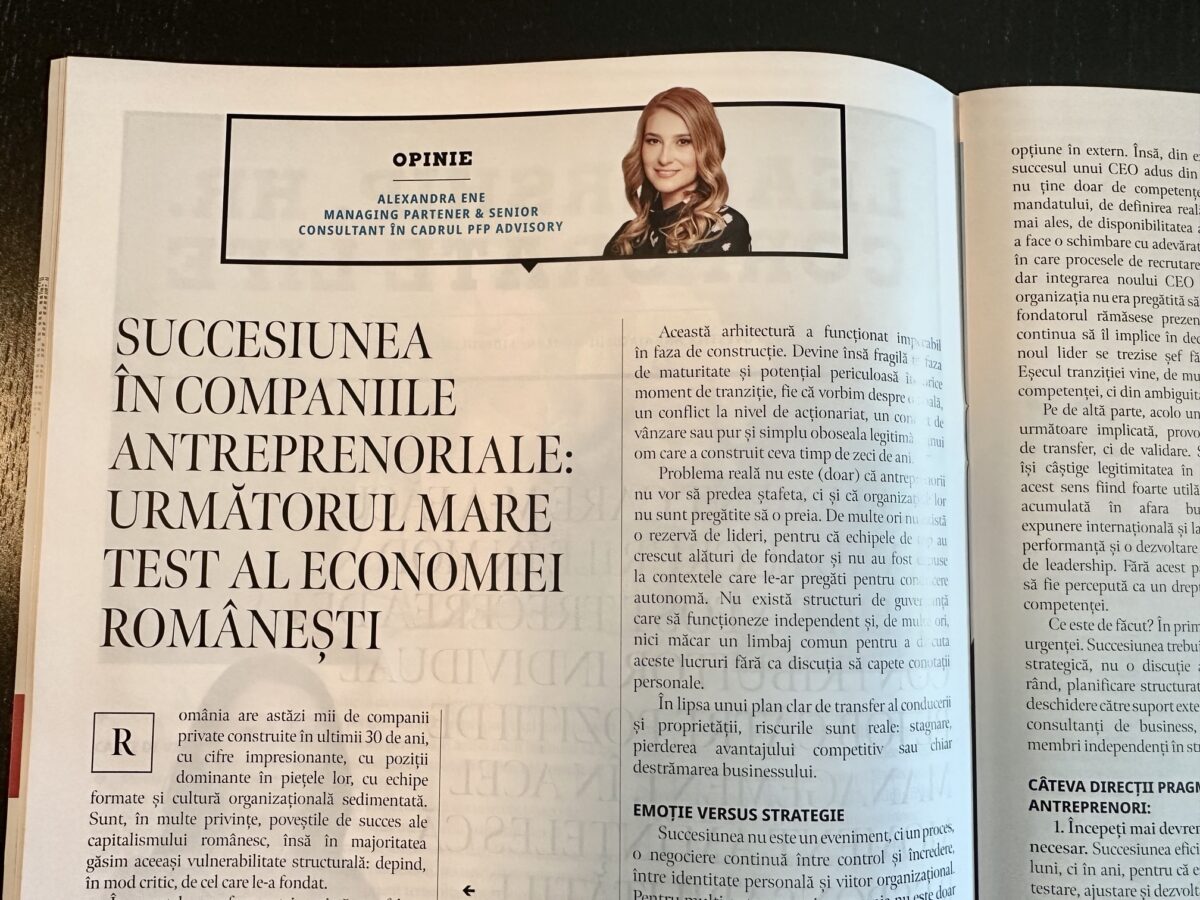
NEWS: Alexandra Ene articol pentru BUSINESS MAGAZIN

Succesiunea în companiile antreprenoriale – următorul mare test al economiei româneşti

Articol scris de Alexandra Ene, Managing Partner & Senior Consultant în cadrul PFP Advisory, pentru publicația Business Magazin.


Succesiunea în companiile antreprenoriale devine unul dintre cele mai importante teste pentru economia românească în perioada următoare, pe fondul maturizării primei generații de antreprenori post-’90. Articolul subliniază că, dincolo de transferul formal de ownership sau management, succesiunea este în esență un proces complex de transformare strategică, care implică redefinirea rolurilor, a culturii organizaționale și a modului de luare a deciziilor.

În practică, una dintre principalele provocări este lipsa unei planificări reale: multe organizații evită conversațiile dificile legate de retragerea fondatorului, delegarea puterii sau pregătirea unei noi generații de leadership. În absența unui proces structurat, riscurile sunt semnificative: de la blocaje decizionale și pierderea direcției strategice până la erodarea valorii companiei.

Articolul evidențiază că succesul succesiunii nu ține doar de identificarea unui „înlocuitor”, ci de alinierea dintre viziunea viitorului lider, etapa de dezvoltare a companiei și disponibilitatea organizației de a accepta schimbarea. Fie că vorbim despre membri ai familiei, management intern sau lideri externi, criteriul critic devine compatibilitatea strategică, nu doar continuitatea.

Concluzia este clară: companiile care tratează succesiunea ca pe un proces de leadership și guvernanță, nu ca pe un eveniment punctual, au șanse reale să conserve valoarea construită și să o ducă mai departe într-un context economic tot mai volatil.

Citete articolul complet aici – https://www.businessmagazin.ro/opinii/alexandra-ene-pfp-advisory-succesiunea-in-companiile-antreprenoriale-23114476