Categorii
Corporate

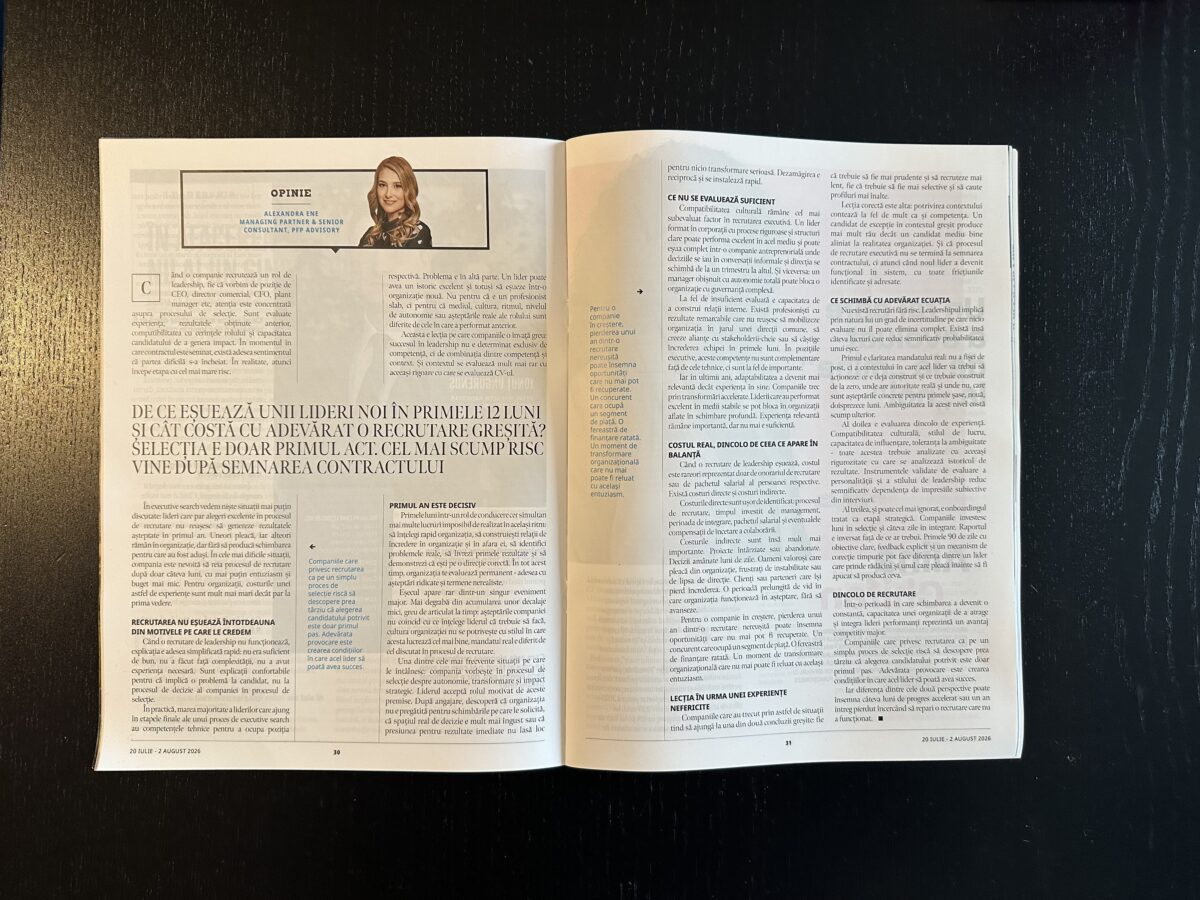
NEWS: Alexandra Ene articol pentru BUSINESS MAGAZIN

O recrutare pentru o poziție de leadership nu se încheie odată cu semnarea contractului. De multe ori, adevărata provocare începe abia atunci, când noul lider trebuie să se adapteze organizației, să construiască relații de încredere și să livreze rezultatele așteptate.

De ce unii lideri cu experiență solidă și rezultate profesionale remarcabile nu reușesc să performeze într-un context nou? Și cât costă, în realitate, o recrutare care nu funcționează?

Într-un articol publicat în Business Magazin, Alexandra Ene, Managing Partner PFP Advisory, analizează factorii care pot contribui la eșecul unei recrutări executive în primele 12 luni, de la diferențele dintre așteptările inițiale și mandatul real, până la compatibilitatea culturală, autonomia decizională și provocările integrării în organizație.

Articolul abordează și costurile mai puțin vizibile ale unei recrutări nereușite: proiecte întârziate, oportunități de business pierdute, instabilitate în echipă și decizii strategice amânate.

Ideea centrală: succesul unei recrutări executive nu depinde doar de alegerea unui candidat competent, ci și de înțelegerea contextului organizațional și de crearea condițiilor în care noul lider poate performa.Coa

Citiți articolul integral în Business Magazin: https://www.businessmagazin.ro/opinii/alexandra-ene-pfp-advisory-de-ce-esueaza-unii-lideri-noi-in-primele-12-luni-si-cat-costa-cu-adevarat-o-recrutare-gresita-selectia-e-doar-primul-act-cel-mai-scump-risc-vine-dupa-semnarea-contractului-23198795
Categorii
Jobs

Commercial Director, FMCG food, Bucharest

We are looking for a Commercial Director for one of our clients, an international company operating in the FMCG sector. The position is based in Bucharest.


THE ROLE

The Commercial Director will take responsibility for the local commercial agenda, covering sales, marketing, key account development, and commercial performance.

Operating within a lean local structure, the role combines  strategic responsibility with a high degree of hands-on involvement. It is therefore particularly suited to a commercially mature leader who is comfortable moving between strategy, key customer discussions, team coordination and direct execution.

This is a build-and-develop mandate, focused on driving profitable growth, strengthening key customer relationships and further developing the commercial function to support the Company’s growth objectives.

Main responsibilities

  • Defining and executing the commercial strategy in alignment with local and Group objectives;
  • Driving profitable growth and identifying new business opportunities across customers, channels and categories;
  • Managing and further developing strategic customer relationships, including leading key commercial negotiations;
  • Defining pricing and promotional strategies, with a strong focus on margins, profitability and sales mix;
  • Leading and coordinating the sales and marketing agenda;
  • Identifying market and category opportunities and supporting new product and business development initiatives;
  • Leading commercial planning, budgeting and forecasting and monitoring key commercial and financial performance indicators;
  • Monitoring market and competitive dynamics to support commercial decision-making;
  • Strengthening commercial processes, performance discipline and accountability;
  • Leading and aligning the commercial team towards the Company’s objectives.


THE CANDIDATE

Professional Profile

  • An FMCG professional, commercially driven and business-minded, with a strong focus on profitable growth;
  • Strategic and analytical, yet pragmatic and hands-on;
  • Entrepreneurial and opportunity-oriented;
  • A strong negotiator and relationship builder, comfortable engaging senior stakeholders;
  • Structured and performance-oriented, with the ability to bring discipline and accountability;
  • A credible and mature leader, able to manage team dynamics effectively;
  • Autonomous and comfortable operating within an international environment.

Requirements

  • Minimum 10 years of relevant FMCG commercial experience, primarily within Sales;
  • Background in the food sector;
  • Strong knowledge of the Romanian Modern Trade market and experience working with international key accounts;
  • Experience with HoReCa customers would be an advantage;
  • Proven experience in complex commercial negotiations;
  • Strong understanding of pricing, margins, profitability and P&L principles;
  • Experience with commercial planning, budgeting and forecasting;
  • Experience coordinating teams and operating across both strategic and operational levels;
  • Exposure to Trade Marketing and/or Marketing;
  • Fluent English and Romanian.
Categorii
Jobs

Chief Financial Officer, Oradea

We are looking for an experienced Chief Financial Officer in Romania for our client, a prominent company in the services sector located in Oradea, Bihor county.


THE ROLE

The future Chief Financial Officer (CFO) should be a highly organized professional with deep financial and accounting expertise, specifically gained within service-oriented or manufacturing environments. You must bring strong technical knowledge to the table and fully grasp the operational workflows specific to service and production companies. The ideal candidate blends hands-on financial-accounting experience with proven team leadership skills and is genuinely excited to take on the challenge of a large-scale project.

Main Responsibilities:

  • Drives the setup of the financial-accounting department and oversees the rollout of the core accounting system;
  • Takes full ownership of the quality, accuracy, and compliance of all financial-accounting activities;
  • Collaborates with executive management to design and implement financial policies, processes, and corporate strategies;
  • Aligns departmental strategies to effectively reach overall business and financial goals;
  • Leads, manages, and supports all team members within the department;
  • Ensures accurate, real-time logging of all financial data within the system software, making sure that the transactions and economic activities are properly reflected in financial terms;
  • Coordinates and oversees corporate billing, collections, payments, and procurement processes;
  • Manages physical and digital inventory records
  • Handles downloading, processing, and validating inventory data within the corporate system;
  • Organizes and coordinates a comprehensive, general inventory audit at least once a year;
  • Partners with HR to recruit, select, hire, and train financial department staff;
  • Prepares periodic internal and external financial reports for stakeholders;
  • Establishes and organizes a reliable physical and digital archive for financial-accounting documents;
  • Coordinates and provides direct support during internal or external financial audits and controlling actions.


INTERNAL STRUCTURE

The future CFO will report to the General Manager, will manage the finance and accounting department and will closely collaborate with other stakeholders, as needed. The position is based in Oradea, Bihor.


THE CANDIDATE

Requirements:

  • Higher education degree in Economics;
  • Specialized coursework in Accounting;
  • Certified Public Accountant (CPA) / ACCA studies represents a strong plus;
  • A minimum of 10 years of experience in the economic / financial-accounting field and at least 2 years of experience in a managerial or leadership position;
  • Deep, practical knowledge of financial and management accounting;
  • Experienced in building, mentoring, and managing teams, as well as designing clear workflows and procedures;
  • Proven track record in setting up and structuring accounting systems;
  • Fully proficient in modern accounting software;
  • Fluent in English and Romanian, both spoken and written.


Professional profile:

  • A mature, high-integrity professional who values and respects organizational rules;
  • Constant attention to monitoring changes in the industry legislation;
  • Rigorous, well-organized, consistent, and exceptionally detail-oriented;
  • Strong analytical and synthesis skills, with a natural eye for spotting potential business risks;
  • Highly intelligent, proactive, and creative when developing risk-management strategies;
  • Very adaptable and quick to pick up new digital tools and systems.
Categorii
Corporate

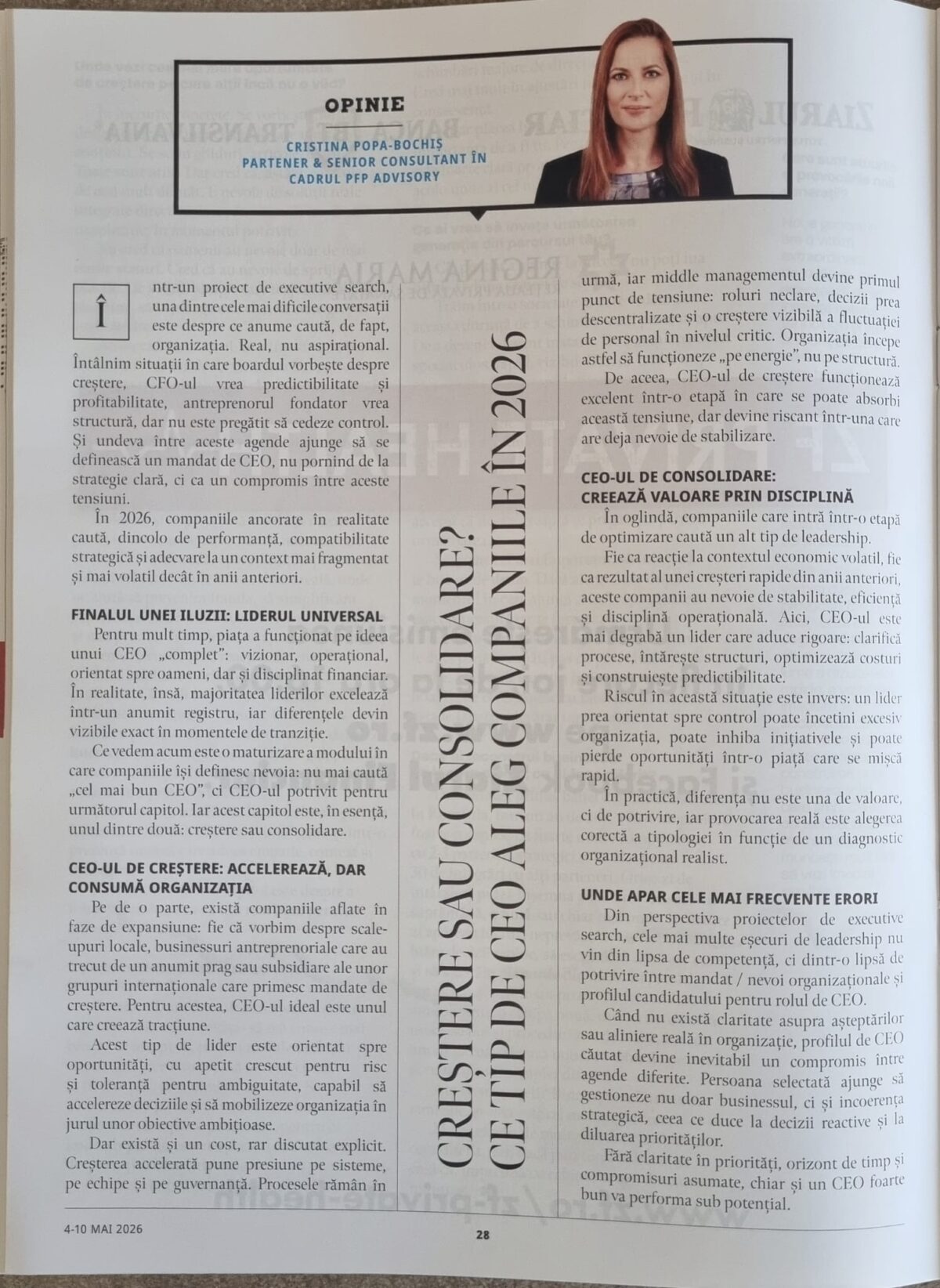
NEWS: Cristina Popa-Bochiş articol pentru BUSINESS MAGAZIN

Creştere sau consolidare? Ce tip de CEO aleg companiile în 2026

Articol scris de Cristina Popa-Bochiş, Partner & Senior Consultant în cadrul PFP Advisory, pentru publicația Business Magazin.


În recrutarea unui CEO, provocarea reală nu este identificarea celui mai bun lider, ci a liderului potrivit pentru etapa în care se află organizația. În practică, multe mandate sunt construite ca un compromis între așteptări diferite ale acționarilor, boardului și managementului, ceea ce face dificilă definirea clară a profilului căutat.

Articolul explorează diferențele dintre CEO-ul orientat spre creștere și CEO-ul orientat spre consolidare, riscurile asociate fiecărei tipologii și motivele pentru care multe eșecuri de leadership nu sunt generate de lipsa de competență, ci de lipsa de potrivire între lider și contextul organizațional.

Într-un mediu economic tot mai volatil, companiile caută lideri cu un nivel ridicat de adaptabilitate (AQ – Adaptability Quotient), capabili să accelereze sau să încetinească organizația atunci când contextul o cere, fără a pierde direcția strategică.

Concluzia este una simplă: organizațiile care reușesc să își clarifice prioritățile, obiectivele și compromisurile înainte de a începe procesul de recrutare au șanse mult mai mari să identifice liderul potrivit și să construiască premisele unui nou capitol de succes.

Citește articolul complet aici – https://www.businessmagazin.ro/opinii/cristina-popa-bochis-partener-senior-consultant-in-cadrul-pfp-23142868

Categorii
Candidates Corporate

POV: Observații despre leadership din executive search

În ultimii ani, unul dintre lucrurile pe care le observ tot mai des la liderii foarte buni este că au devenit mult mai puțin preocupați să pară că au toate răspunsurile. Pun întrebări mai bune, cer feedback real, își schimbă opinia când apar informații noi, recunosc mai ușor când ceva nu funcționează, vorbesc onest (și) despre greșelile pe care le-au făcut.

Și, poate cel mai important, nu mai construiesc organizații dependente de ei.

Liderii care performează bine în perioade complicate nu sunt cei care conduc prin presiune, control sau urgență permanentă, ci cei care reușesc să păstreze claritate, prioritizare și un anumit echilibru în organizație chiar și în momente mai dificile.

În recrutare, diferența asta o vedem între cei care vor să pară că lucrurile nu le scapă niciodată de sub control și vor să conducă fiecare conversație, și cei vorbesc despre cum au construit echipe și structuri menite să funcționeze sănătos și fără prezența lor constantă.

Cred că leadershipul modern seamănă mai puțin cu imaginea clasică a „omului care știe și face tot” și mai mult cu capacitatea de a adapta, de a învăța, de a crește oameni și de a păstra organizația funcțională într-un context care se schimbă permanent.

Postare publicată de Alexandra Ene pe LinkedIn.

Categorii
Corporate

Alexandra Ene on Euronews regarding the EU Pay Transparency Directive

Euronews invited Alexandra Ene, Managing Partner PFP Advisory, to discuss with Sonia Teodoriu the implementation of the EU Pay Transparency Directive and its impact on organizations in Romania.

Many companies in Romania are currently insufficiently prepared for this new stage of transparency and compliance. However, it is important for both employers and employees to understand that, although reporting obligations will begin next year, the deadline for transposing the directive into national legislation is June 2026.

In practice, the directive will require organizations to:

  • Evaluate roles and implement clear and transparent compensation structures;
  • Ensure equal pay for women and men performing the same work or work of equal value;
  • Communicate to employees both their individual remuneration level and the average remuneration levels for employees performing the same work or work of equal value within the organization;
  • Inform candidates during recruitment processes about the salary range associated with the role;
  • Report gender pay gap data for companies with more than 100 employees.

Beyond compliance, the directive is likely to force many organizations to reassess how compensation decisions are made, documented, and communicated internally. In practice, this is not only an HR or legal exercise, but also a leadership and organizational maturity topic, especially for companies that grew rapidly or developed compensation structures organically over time.

For many organizations, the real challenge will not be reporting itself, but the inconsistencies that transparency may expose: differences generated over time by negotiation practices, legacy structures, unclear role evaluations, or uneven managerial decisions.

Companies that prepare will likely navigate the transition with significantly less internal friction.

See the video here – https://www.youtube.com/watch?v=tU-VE-3Hu18

Read the article here – https://www.euronews.ro/articole/transparenta-salariala-bate-la-usa-cat-de-pregatite-sunt-companiile-si-ce-presupune-proiectul-de-lege

Categorii
Corporate

POV: Adecvarea leadershipului și momentul deciziilor dificile

Uneori, problema în companie nu este strategia. Ci persoana care trebuie să o execute.

Spun asta cu prudență, pentru că schimbarea unui lider nu e niciodată o decizie ușoară. Dar în munca mea de executive search am văzut de mai multe ori organizații care încercau să „repare” rezultate prin ajustări de plan, bugete sau structură… când, de fapt, blocajul era la nivel de leadership.

Câteva semne pe care le-am observat în timp:
– Creșterea stagnează de 2–3 ani, deși piața oferă oportunități. Nu e declin, dar nici progres sau energie de accelerare, doar o zonă de confort prelungită.
– Turnover ridicat în middle management. Oamenii buni pleacă nu neapărat din cauza companiei, ci din cauza direcției sau lipsei de claritate.
– Board-ul vorbește despre transformare, inovație, curaj. Organizația răspunde cu prudență excesivă, amânări, multe motive pentru care „nu e momentul”.
– CEO-ul este permanent în operațional. Stinge incendii, intră în detalii, decide lucruri care ar trebui să fie delegate, iar strategia rămâne pe slide-uri.

Diferența importantă este că un lider potrivit pentru stabilitate nu este automat potrivit pentru scalare sau transformare. Iar când lucrurile nu merg, nu spun că soluția este întotdeauna „schimbăm liderul”. Uneori se poate încerca redefinirea rolului, sprijin extern, coaching sau reașezarea echipei. Alteori însă, organizația a crescut mai repede decât liderul ei.

Adecvarea leadershipului nu este o etichetă permanentă, ci este contextuală. Prin urmare, una dintre cele mai mature întrebări pe care un board sau un antreprenor și le poate pune este: „ Este acest lider potrivit pentru direcția în care vrem să ducem compania?”

Articol scris de Alexandra Ene, Managing Partner & Senior Consultant PFP Advisory pentru LinkedIn.


Ai nevoie de sprijin pentru recrutarea următorului lider în organizația ta? Te putem ajuta: https://pfpadvisory.com/contact/

Categorii
Corporate

Balancing experience and potential in management recruitment

Decoding Talent Acquisition: Balancing experience and potential when recruiting a manager is a nuanced process that depends on the specific needs and goals of your organization. Here’s a breakdown of both perspectives:

Experience:
  • Proven Track Record: Experienced managers have background in handling various challenges, making them equipped to manage different situations more effectively. Encountering and resolving various issues in past roles equips senior candidates with problem-solving skills that can be applied to new situations. This can save time and resources when dealing with complex issues.
  • Immediate Impact: They often require less training and can contribute to the organization’s goals more quickly due to their familiarity with similar roles. They can often hit the ground running, being a what we call a “plug & play” profile.
  • Risk Reduction: Their experience can mean high-quality work and more appropriate decisions, reducing the potential for costly mistakes and allowing them to provide guidance to their team based on past experiences.
  • Reduced Learning Curve: Learning curves are inherent to any new role. However, experienced candidates often have a shorter learning curve, allowing them to adapt to new processes and technologies more swiftly.
  • Mentorship Potential: Experienced employees can serve as mentors to less experienced team members. They can provide guidance, share insights, and contribute to the growth and development of the team, facilitating knowledge transfer within the organization. Furthermore, having experienced mentors can help retain top talent, as employees value opportunities for growth and learning. When new hires see that the organization invests in their development by providing access to experienced mentors, they’re more likely to feel engaged and motivated to contribute effectively.
  • Client and Stakeholder Relations: In roles that involve interacting with clients and stakeholders, experienced candidates are more likely to have established relationships and a better understanding of client needs.
  • Leadership and Decision-Making: In managerial roles, experience often leads to better decision-making and effective leadership. Experienced managers can draw on past experiences to guide their teams and drive results.
  • Crisis Management: When unexpected challenges arise, experienced professionals tend to remain calm and composed, drawing from their past experiences to manage crises effectively.
  • Industry Insights: Experienced candidates bring insights about industry trends, competition, and market dynamics that can be invaluable in shaping business strategies.
  • Confidence and Poise: Another advantage of recruiting a person with experience is the confidence and poise they bring to their role. Seniority often equips individuals with a sense of assurance in their abilities. Having faced and overcome various challenges in their career, experienced professionals tend to approach new tasks and responsibilities with a level of self-assuredness. This confidence can have a positive impact on their performance, decision-making, and interactions with colleagues, clients, and stakeholders.

However, past performance does no guarantee future performance, which is why high potential candidates should still be in the run.

Potential:
  • Fresh Perspectives: Individuals with less experience, unburdened by preconceived notions, often bring to the table creative thinking, original viewpoints and innovative ideas that can challenge the status quo. This encourages a culture of continuous improvement and fosters a mindset of innovation which can drive the organization to explore new opportunities.
  • Adaptability: Potential-driven managers tend to be more open to learning and adapting to changing contexts, which is essential in today’s rapidly evolving business landscape. Their proactive approach to evolving circumstances can lead to the organization remaining responsive and resilient.
  • Long-Term Investment: By identifying and nurturing high-potential individuals, organizations make a strategic investment in their future top leadership pipeline. These candidates possess qualities that can be developed over time, aligning with the organization’s growth trajectory and long-term vision.
  • Eagerness to Learn: High-potential candidates are typically eager to learn and take on new challenges. Their curiosity can lead to continuous improvement and a culture of ongoing development.
  • Energy and Enthusiasm: Their enthusiasm and passion can be contagious, boosting team morale and motivation, and fostering a positive work environment. Thus, they could have an impact on team spirit, elevating engagement levels, and cultivating an atmosphere where challenges are seen as exciting opportunities to excel.
  • Resilience: High-potential candidates often exhibit a high level of determination and resilience, enabling them to bounce back from setbacks and persevere in the face of challenges.
  • Diverse Skill Sets: These candidates may come from various backgrounds, bringing miscellaneous skill sets that can complement and enrich the existing team’s capabilities. Their distinctive capabilitities could bring fresh dimensions to problem-solving and decision-making, driving well-rounded outcomes.
  • Leadership Potential: Even if they’re not stepping into a top role immediately, high-potential candidates often display leadership qualities that can be nurtured and developed over time.
  • Cultural Fit: Being relatively new to the organization, these candidates are more likely to embrace and embody the company’s culture, making integration smoother.
  • Retention and Engagement: Organizations that invest in high-potential individuals demonstrate a commitment to employee growth and development, which can lead to increased job satisfaction, engagement, and retention.
Finding the Balance:
  • Context Matters: Consider the specific role, team, and company goals. For critical positions requiring immediate results, experience might be prioritized. For roles with room for growth and innovation, potential could be more valuable.
  • Hybrid Approach: Look for candidates who offer a blend of both. Someone with a strong foundation of experience combined with a demonstrated hunger to learn and grow can be a valuable asset.
  • Assessment Tools: Utilize assessment tools, psychometric tests, competency-based interviews, simulations, and scenario-based assessments to gauge a candidate’s ability to handle real-world situations, regardless of experience.
  • Investment in Development: If you lean towards potential, ensure you have a solid plan for mentoring, training, and guiding the manager to meet your organization’s expectations.


In essence, the best approach is to prioritize what aligns with your organization’s immediate and long-term needs. Remember that each recruitment scenario is unique. Therefore, carefully evaluating candidates based on your organization’s circumstances and culture will yield the best outcome.